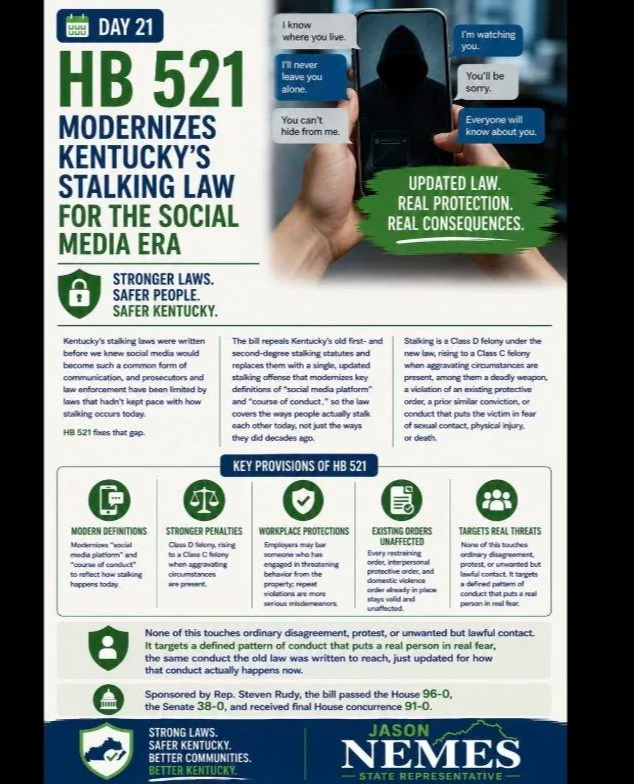
Day 21: Modernizes Kentucky's Stalking Law for the Social Media Era (HB 521)

Kentucky’s stalking laws were written before we knew social media would become such a common form of communication, and prosecutors and law enforcement have been limited by laws that hadn’t kept pace with how stalking occurs today. HB 521 fixes that gap.

The bill repeals Kentucky’s old first- and second-degree stalking statutes and replaces them with a single, updated stalking offense that modernizes key definitions of “social media platform” and “course of conduct,” so the law covers the ways people actually stalk each other today, not just the ways they did decades ago. Stalking is a Class D felony under the new law, rising to a Class C felony when aggravating circumstances are present, among them a deadly weapon, a violation of an existing protective order, a prior similar conviction, or conduct that puts the victim in fear of sexual contact, physical injury, or death. The bill also strengthens workplace protections, allowing an employer to bar someone who has engaged in threatening behavior from the property, with repeat violations treated as more serious misdemeanors. Every restraining order, interpersonal protective order, and domestic violence order already in place stays valid and unaffected.

None of this touches ordinary disagreement, protest, or unwanted but lawful contact. It targets a defined pattern of conduct that puts a real person in real fear, the same conduct the old law was written to reach, just updated for how that conduct actually happens now.

Sponsored by Rep. Steven Rudy, the bill passed the House 96-0, the Senate 38-0, and received final House concurrence 91-0.
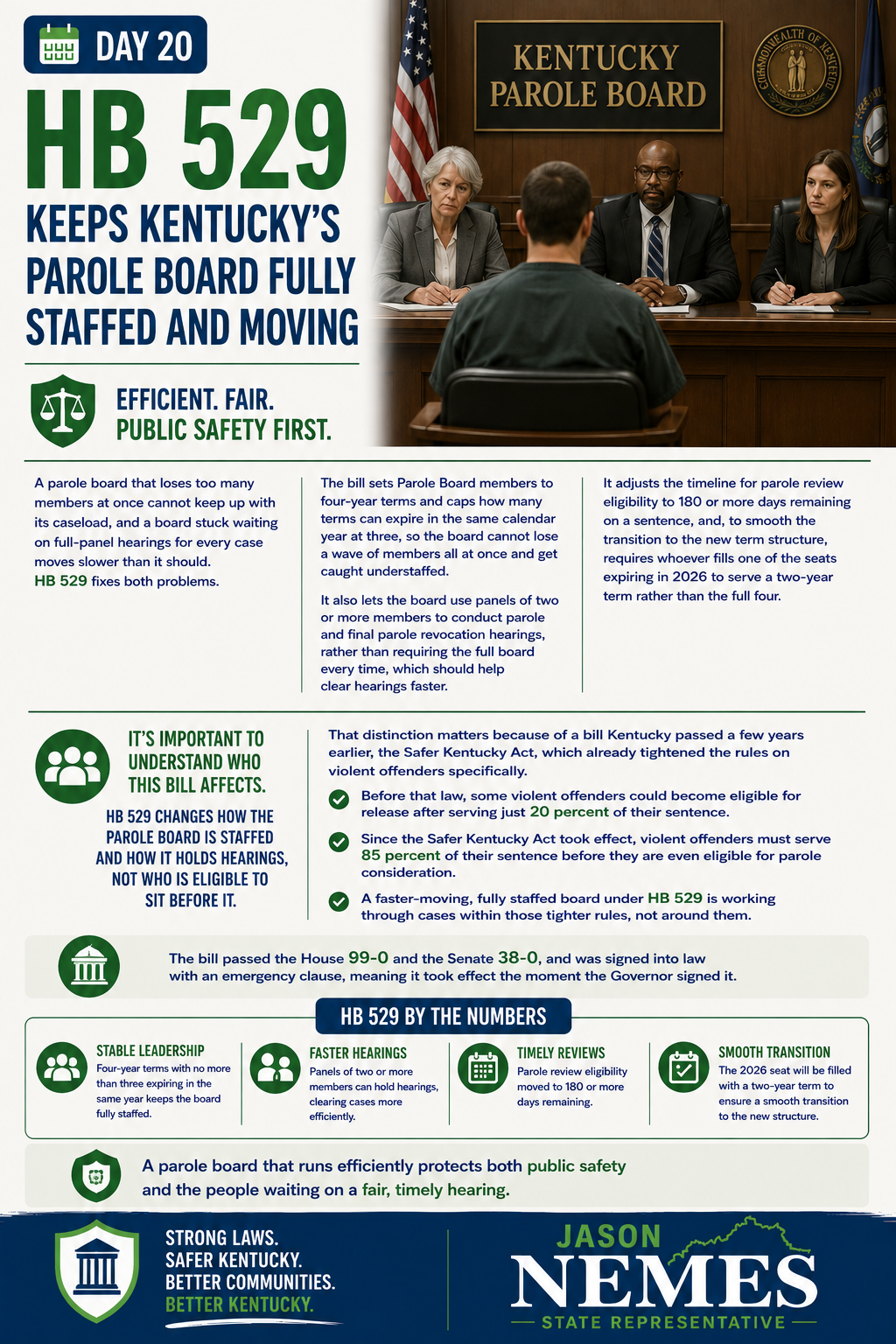
Day 20: Keeps Kentucky's Parole Board Fully Staffed and Moving (HB 529)

A parole board that loses too many members at once cannot keep up with its caseload, and a board stuck waiting on full-panel hearings for every case moves slower than it should. HB 529 fixes both problems.

The bill sets Parole Board members to four-year terms and caps how many terms can expire in the same calendar year at three, so the board cannot lose a wave of members all at once and get caught understaffed. It also lets the board use panels of two or more members to conduct parole and final parole revocation hearings, rather than requiring the full board every time, which should help clear hearings faster. (But when a smaller panel is not unanimous, then the case gets transferred to the entire panel, so we can ensure nobody gets released with too few board members reviewing the case.) It adjusts the timeline for parole review eligibility to 180 or more days remaining on a sentence, and, to smooth the transition to the new term structure, requires whoever fills one of the seats expiring in 2026 to serve a two-year term rather than the full four.

It’s worth being clear about who this bill affects. HB 529 changes how the Parole Board is staffed and how it holds hearings, not who is eligible to sit before it. That distinction matters because of a bill Kentucky passed a few years earlier, the Safer Kentucky Act, which already tightened the rules on violent offenders specifically. Before that law, some violent offenders could become eligible for release after serving just 20 percent of their sentence. Since the Safer Kentucky Act took effect, violent offenders must serve 85 percent of their sentence before they are even eligible for parole consideration. A faster-moving, fully staffed board under HB 529 is working through cases within those tighter rules, not around them.

The bill passed the House 99-0 and the Senate 38-0, and was signed into law with an emergency clause, meaning it took effect the moment the Governor signed it. A parole board that runs efficiently protects both public safety and the people waiting on a fair, timely hearing.

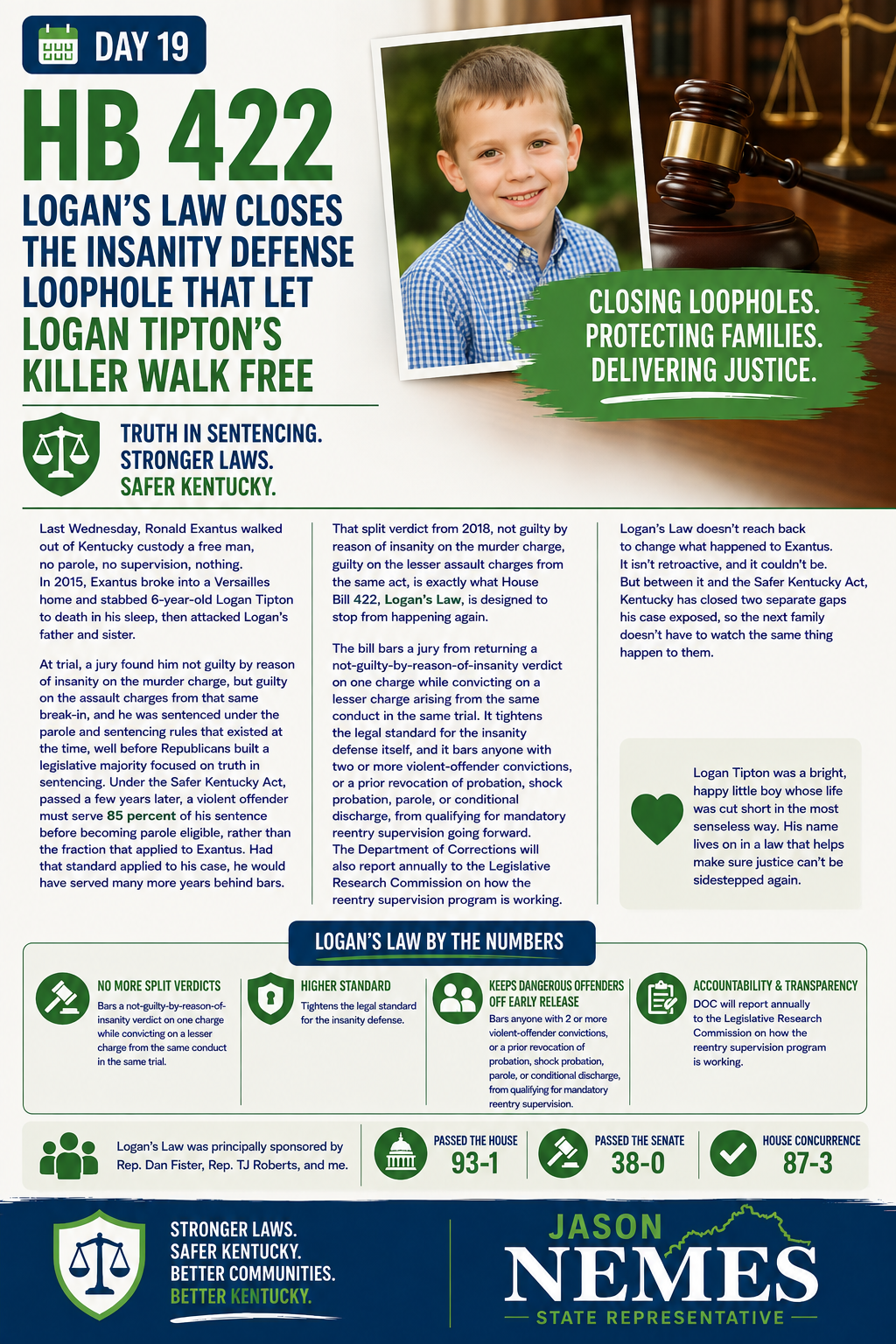
Day 19: Logan's Law Closes the Insanity Defense Loophole That Let Logan Tipton's Killer Walk Free (HB 422)

Day 19: Logan's Law Closes the Insanity Defense Loophole That Let Logan Tipton's Killer Walk Free (HB 422)

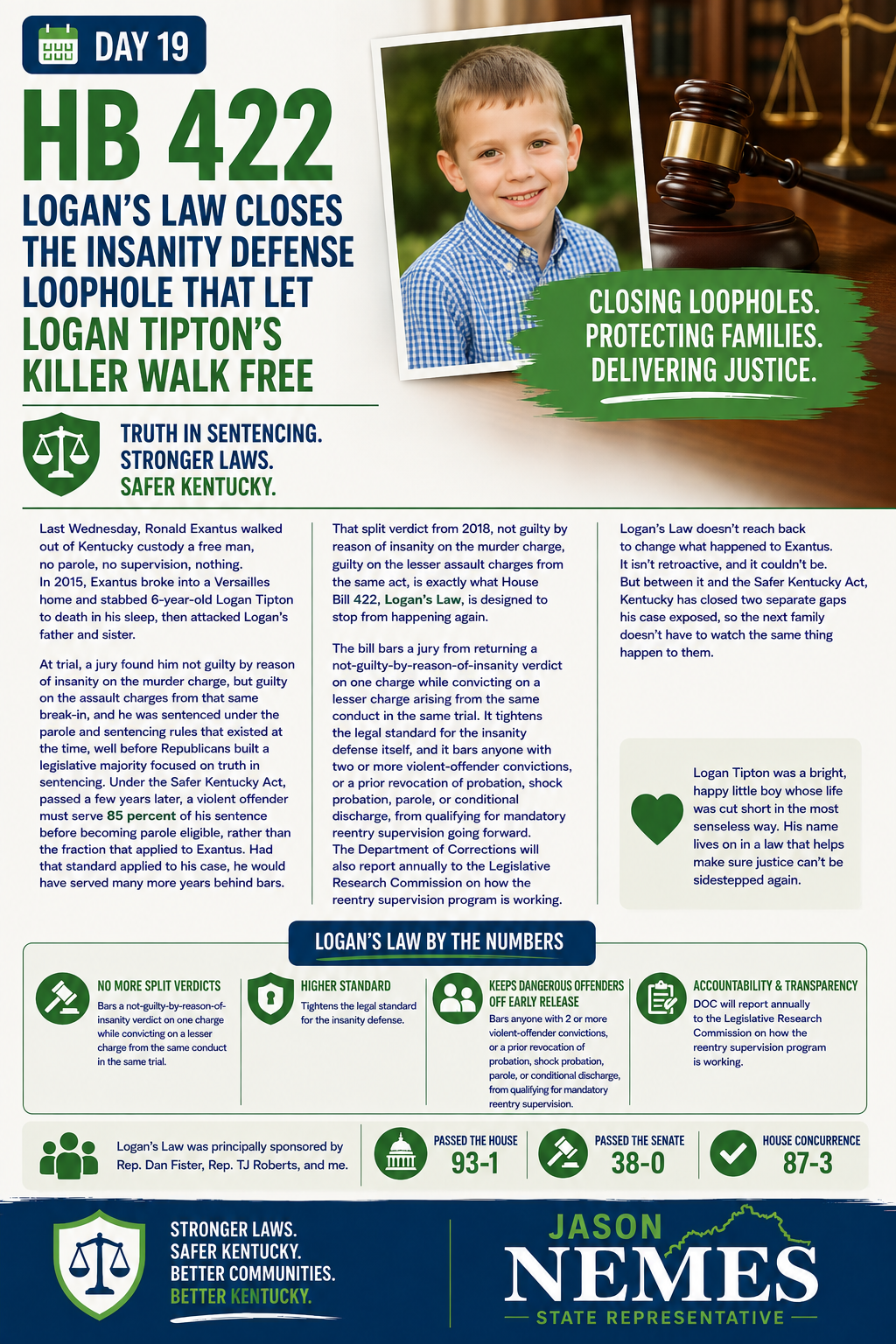
Last Wednesday, Ronald Exantus walked out of Kentucky custody a free man, no parole, no supervision, nothing. In 2015, Exantus broke into a Versailles home and stabbed 6-year-old Logan Tipton to death in his sleep, then attacked Logan’s father and sister. At trial, a jury found him not guilty by reason of insanity on the murder charge, but guilty on the assault charges from that same break-in, and he was sentenced under the parole and sentencing rules that existed at the time, well before Republicans built a legislative majority focused on truth in sentencing. Under the Safer Kentucky Act, passed a few years later, a violent offender must serve 85 percent of his sentence before becoming parole eligible, rather than the fraction that applied to Exantus. Had that standard applied to his case, he would have served many more years behind bars.

That split verdict from 2018, not guilty by reason of insanity on the murder charge, guilty on the lesser assault charges from the same act, is exactly what House Bill 422, Logan’s Law, is designed to stop from happening again. The bill bars a jury from returning a not-guilty-by-reason-of-insanity verdict on one charge while convicting on a lesser charge arising from the same conduct in the same trial. It tightens the legal standard for the insanity defense itself, and it bars anyone with two or more violent-offender convictions, or a prior revocation of probation, shock probation, parole, or conditional discharge, from qualifying for mandatory reentry supervision going forward. The Department of Corrections will also report annually to the Legislative Research Commission on how the reentry supervision program is working.

Logan’s Law doesn’t reach back to change what happened to Exantus. It isn’t retroactive, and it couldn’t be. But between it and the Safer Kentucky Act, Kentucky has closed two separate gaps his case exposed, so the next family doesn’t have to watch the same thing happen to them.

Logan’s Law was principally sponsored by Rep. Dan Fister, Rep. TJ Roberts, and me, passing the House 93-1, the Senate 38-0, and receiving final House concurrence 87-3.

Day 18: Updates Kentucky's Election Administration (HB 139)

Day 18: Updates Kentucky's Election Administration (HB 139)

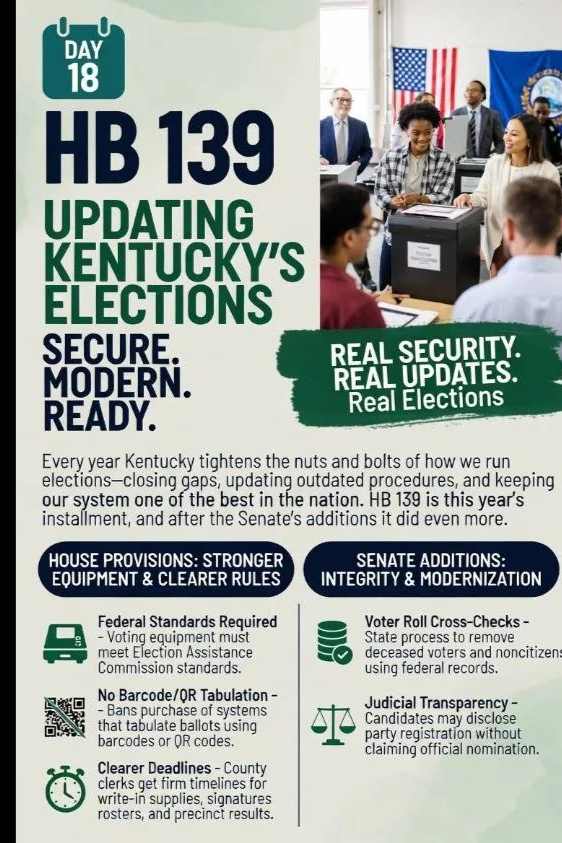
Every year, Reps. Jennifer Decker, DJ Johnson, and John Hodgson lead a bipartisan push to tighten up the nuts and bolts of how Kentucky runs its elections, closing gaps that turned up in the last cycle and updating outdated procedures before they cause a problem at the ballot box. HB 139 is this year’s installment, and after the Senate added provisions of its own, it ended up doing more than usual.

As introduced, the bill requires voting equipment to meet federal Election Assistance Commission standards, bans the purchase of voting systems that tabulate ballots using barcodes or QR codes, gives county clerks a clearer deadline to stock write-in ballot supplies, and tightens the timeline for delivering signature rosters and precinct results after an election. The Senate then added its own election integrity measures: a process for the state to cross-check voter rolls against federal records to remove deceased voters and noncitizens, an update bringing our laws into compliance with what courts have required in allowing judicial candidates to disclose their party registration, an increase in the campaign finance reporting threshold from $100 to $200, and connecting the amount one may contribute to a state candidate to the federal level, the first adjustment in years.

The House passed the bill 92-1. After the Senate’s changes, the Governor vetoed it, and the General Assembly overrode the veto, 80-20 in the House and 32-6 in the Senate.

Elections work best when both the rules and the equipment keep pace with the technology and the calendar. HB 139 is Frankfort doing that routine maintenance.

Day 17: Holding parents accountable, not just kids (SB 170)

Day 17: Holding parents accountable, not just kids (SB 170)

“Where are the parents?” That’s the question Kentuckians ask, over and over, when a kid ends up in real trouble. It’s a fair question. For too long, our system treated a struggling child as if the problem started and ended with the kid, while the parents stood off to the side, uninvolved and unaccountable. That’s not fair to the child, and it’s not fair to the community that has to deal with the consequences.

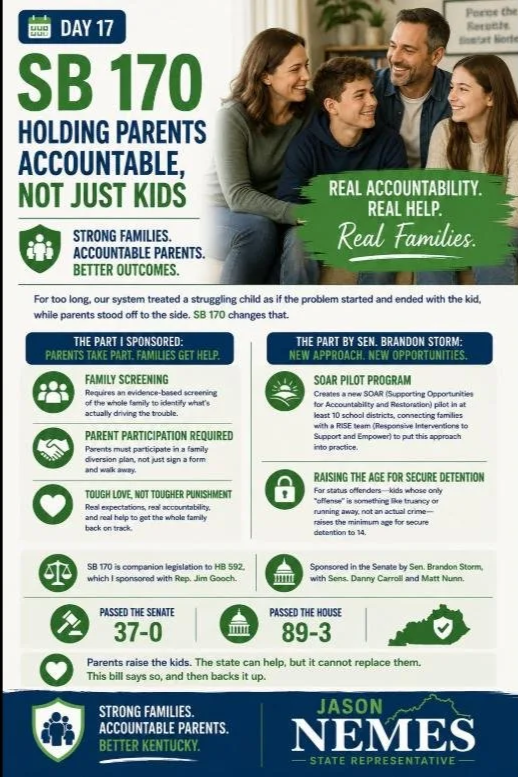
I sponsored the part of SB 170 that changes this. When a family comes into contact with the system over something like truancy, it’s no longer just about fixing the kid. The law now requires an evidence-based screening of the whole family to identify what’s actually driving the trouble, and it requires the parents themselves to participate in a family diversion plan, not just sign a form and walk away. Parents don’t get to dump their child’s struggles onto the school, the court, or the state and call it handled. At the same time, this isn’t about punishing families and calling it a day. It’s tough love: real expectations, real accountability, and real help to get the whole family back on track, because a fixed kid with a broken home behind him doesn’t stay fixed for long.

But that is just half of SB 170. The other half was crafted by Sen. Brandon Storm, the Senate Judiciary Committee Chairman. His portion of the bill creates a new pilot program, SOAR (Supporting Opportunities for Accountability and Restoration), in at least 10 public school districts, connecting families with a RISE team (Responsive Interventions to Support and Empower) that puts this whole approach into practice. And for status offenders generally, kids whose only “offense” is something like truancy or running away, not an actual crime, the bill raises the minimum age for secure detention to 14, so young children aren’t being locked up in a facility built for juvenile crime over a school attendance problem.

SB 170, which is now law, was companion legislation to HB 592, which I sponsored with Rep. Jim Gooch. Sponsored in the Senate by Sen. Brandon Storm, with Sens. Danny Carroll and Matt Nunn. Passed the Senate 37-0 and the House 89-3.

Parents raise the kids. The state can help, but it cannot replace them. This bill says so, and then backs it up.

Day 16: Closing the door on last-minute shenanigans by the governor (HB 10 and SB 10)

Day 16: Closing the door on last-minute shenanigans by the governor (HB 10 and SB 10)

We’ve seen shenanigans by both parties. On his way out of office, Matt Bevin issued over 600 pardons and commutations in his final weeks, including for people convicted of rape, murder, and child abuse. I believe in the pardon power, but some of those pardons were inexcusable. Before Bevin, Steve Beshear’s administration handed a multi-million, no-bid contract to a company with a direct financial tie to one of his own cabinet secretaries (it was his budget director’s husband) on his literal last day in office. This isn’t a partisan problem. It’s a structural one: an outgoing administration facing no more elections has every incentive to do favors, settle scores, hand out benefits, and protect his cronies, on the way out the door, with the next administration and the people of Kentucky left to live with it.

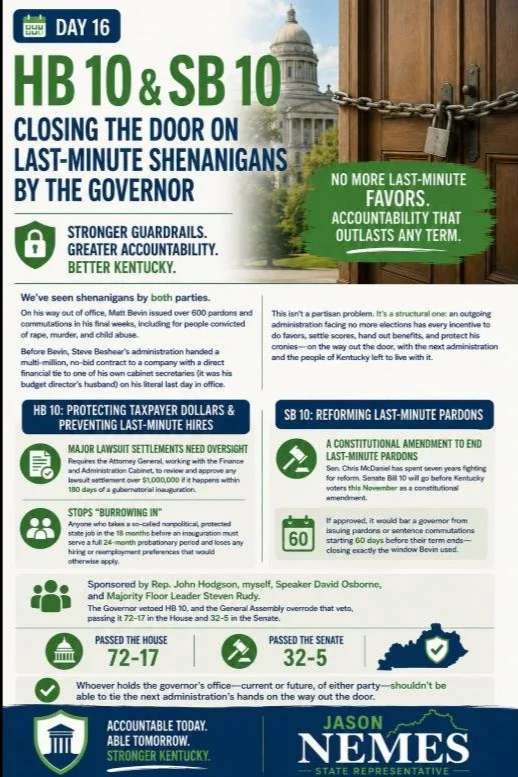
HB 10 addresses the money and personnel side of that problem. It requires the Attorney General, working with the Finance and Administration Cabinet, to review and approve any settlement of a lawsuit worth more than $1,000,000 if it happens within 180 days of a gubernatorial inauguration. It also stops the practice of “burrowing in,” where a political appointee gets converted into a supposedly nonpolitical, protected state job right before their boss leaves office; anyone who takes such a position in the 18 months before an inauguration now has to serve a full 24-month probationary period and loses any hiring or reemployment preferences that would otherwise apply.

With regard to last-minute pardons, Sen. Chris McDaniel has spent seven years fighting for reform. His proposal, Senate Bill 10, will finally go before Kentucky voters this November as a constitutional amendment. If approved, it would bar a governor from issuing pardons or sentence commutations starting 60 days before their term ends, closing exactly the window Bevin used.

Sponsored by Rep. John Hodgson, myself, Speaker David Osborne, and Majority Floor Leader Steven Rudy. The Governor vetoed HB 10, and the General Assembly overrode that veto, passing it 72-17 in the House and 32-5 in the Senate.

Whoever holds the governor’s office, current or future, of either party, shouldn’t be able to tie the next administration’s hands on the way out the door.

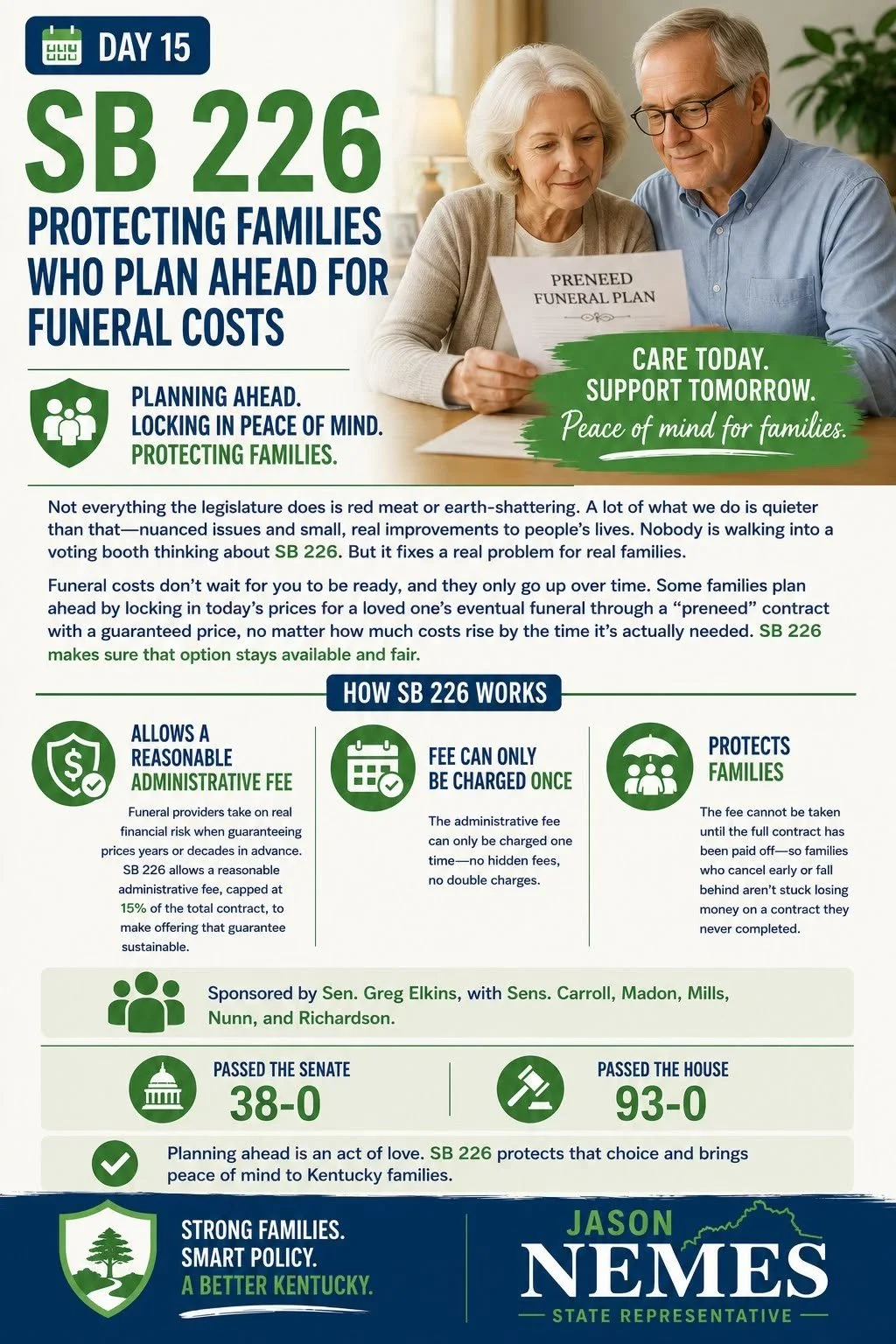
Day 15: Protecting families who plan ahead for funeral costs (SB 226)

Day 15: Protecting families who plan ahead for funeral costs (SB 226)

Not everything the legislature does is red meat or earth-shattering. A lot of what we do is quieter than that, nuanced issues and small, real improvements to people’s lives. Nobody is walking into a voting booth thinking about SB 226. But it fixes a real problem for real families.

Funeral costs don’t wait for you to be ready, and they only go up over time. Some families plan ahead by locking in today’s prices for a loved one’s eventual funeral through what’s called a “preneed” contract with a guaranteed price, no matter how much costs rise by the time it’s actually needed. SB 226 makes sure that option stays available and fair.

To offer a guaranteed price years or decades in advance, the funeral provider is taking on real financial risk if costs rise faster than expected. SB 226 allows that provider to charge a reasonable administrative fee, capped at 15% of the total contract, to make offering that guarantee sustainable. But it also protects the family on the other side: that fee can only be charged once, and it can’t be taken out until the full contract has actually been paid off, so a family who cancels early or falls behind isn’t stuck losing money to a fee on a contract they never completed.

Sponsored by Sen. Greg Elkins, with Sens. Carroll, Madon, Mills, Nunn, and Richardson. Passed the Senate 38-0 and the House 93-0.

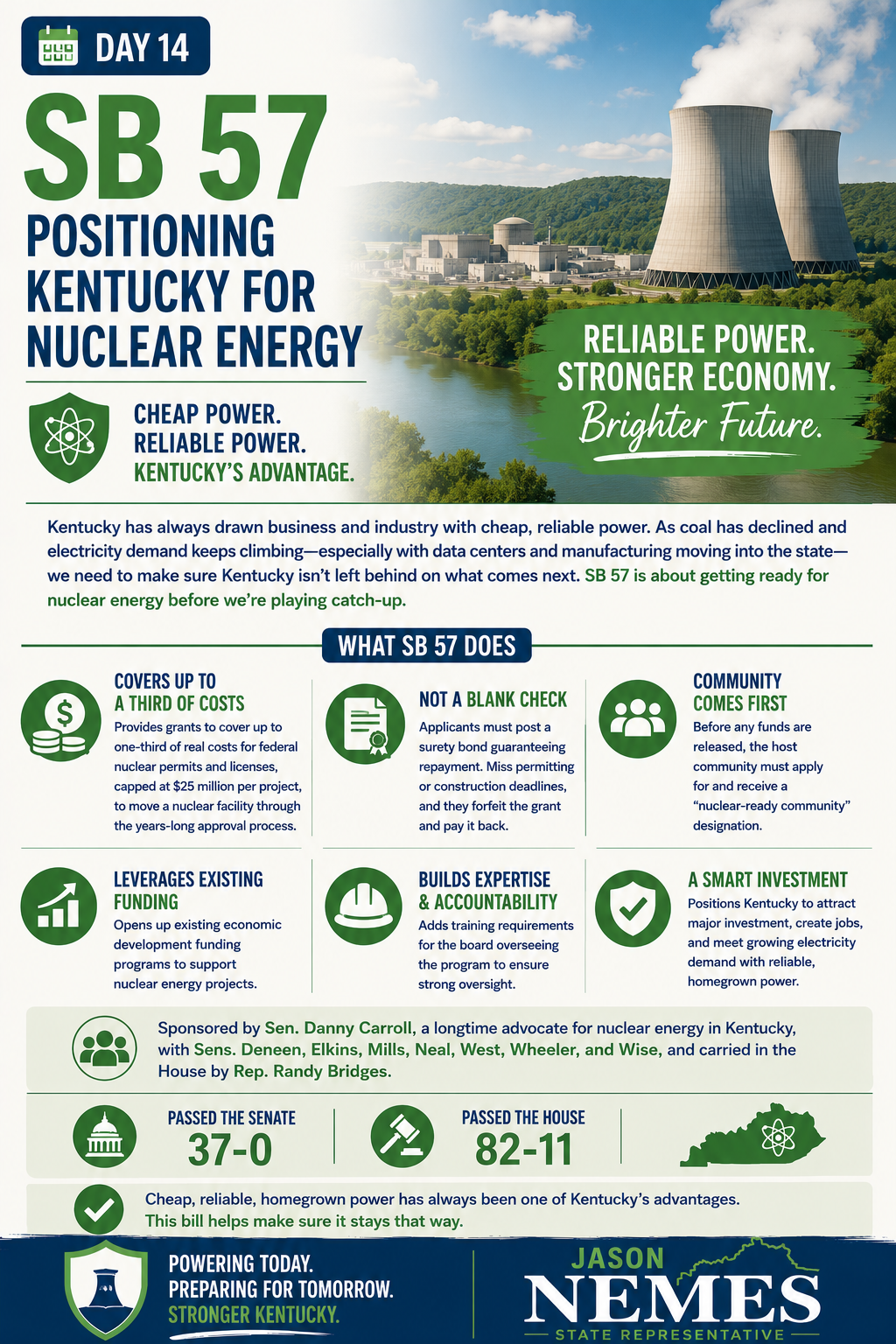
Day 14: Positioning Kentucky for nuclear energy (SB 57)

Day 14: Positioning Kentucky for nuclear energy (SB 57)

Kentucky has always drawn business and industry with cheap, reliable power. As coal has declined and electricity demand keeps climbing, especially with data centers and manufacturing moving into the state, we need to make sure Kentucky isn’t left behind on what comes next. SB 57 is about getting ready for nuclear energy before we’re playing catch-up.

The bill creates a grant program that can cover up to a third of the real costs a company faces in applying for federal nuclear permits and licenses, capped at $25 million per project, to help get a nuclear facility through the years-long federal approval process. It’s not a blank check: applicants have to post a surety bond guaranteeing repayment, and if they don’t hit their permitting or construction deadlines, they forfeit the grant and pay it back. Before any of that money moves, the community where the facility would be built has to apply for and receive a “nuclear-ready community” designation, so local buy-in comes first. The bill also opens up existing economic development funding to nuclear projects and adds training requirements for the board overseeing all of it.

Sponsored by Sen. Danny Carroll, a longtime advocate for nuclear energy in Kentucky, with Sens. Deneen, Elkins, Mills, Neal, West, Wheeler, and Wise, and carried in the House by Rep. Randy Bridges. Passed the Senate 37-0 and the House 82-11.

Cheap, reliable, homegrown power has always been one of Kentucky’s advantages. This bill helps make sure it stays that way.

Day 13: Real diploma pathways for students with disabilities (HB 562)

Day 13: Real diploma pathways for students with disabilities (HB 562)

For students with disabilities who can’t meet the requirements of a standard diploma, Kentucky law didn’t offer much of a real, structured alternative, in practice, districts often improvised, and options varied district to district. HB 562 fixes that with two new statewide options: an alternate high school diploma and a modified high school diploma, each with clear, defined requirements set by the Kentucky Board of Education.

This isn’t just about handing out a piece of paper. The bill also requires the Department of Workforce Development to build and publish a list of employers actually willing to hire someone who holds an alternate diploma, so there’s a real bridge from graduation to a job. And a modified diploma now counts for state scholarship eligibility the same way an alternate diploma does, so a student isn’t shut out of financial aid because of which diploma path fit them best.

Sponsored by Rep. Thomas Truett, with 27 additional House co-sponsors. It passed the House 96-0, the Senate 36-0, and cleared final concurrence 95-0, about as close to universal agreement as you’ll find at the Capitol.

Every kid deserves a real path forward, not just the same path forced to fit everyone. This bill builds one.

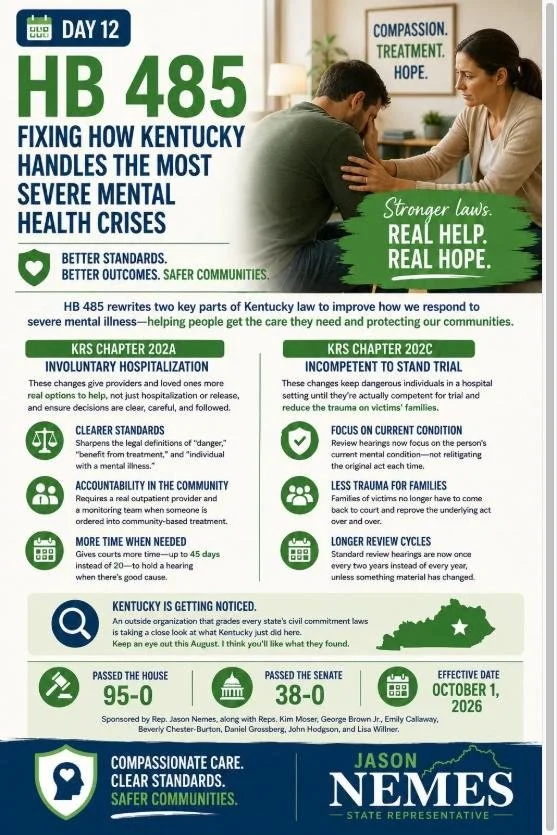
Day 12: Fixing how Kentucky handles the most severe mental health crises (HB 485)

Day 12: Fixing how Kentucky handles the most severe mental health crises (HB 485)

HB 485 rewrites two different parts of how Kentucky handles severe mental illness, and both matter.

The first is KRS Chapter 202A, the law governing involuntary hospitalization for people in a mental health crisis. The changes here are about giving providers and loved ones more real options to actually help someone, instead of a system where a person either gets hospitalized or gets released with little in between. The bill sharpens the legal definitions of “danger,” “benefit from treatment,” and “individual with a mental illness” so courts, doctors, and families are working from the same clear standard instead of ambiguous language. It requires a real outpatient provider and a monitoring team to be appointed when someone is ordered into community-based treatment, so that order actually gets followed up on. And it gives courts more time, up to 45 days instead of 20, to hold a hearing when there’s good cause, so decisions aren’t rushed before all the facts are in.

The second is KRS Chapter 202C, which governs people found incompetent to stand trial due to their mental condition, often in serious, violent cases. The goal here is to keep a genuinely dangerous person in a hospital setting until they’re actually competent to face trial, rather than releasing them prematurely. Under the old law, families of victims had to come back to court and essentially reprove that the person committed the underlying act, over and over, every single review hearing. That’s real trauma, repeated again and again. HB 485 shifts the focus of these ongoing hearings to the person’s current mental condition rather than relitigating the original act each time, and it spaces out standard review hearings to once every two years instead of every year, unless something material has actually changed.

Sponsored by me, along with Reps. Kim Moser, Lisa Willner, George Brown Jr., Emily Callaway, Beverly Chester-Burton, Daniel Grossberg, John Hodgson. Passed the House 95-0. And a special thanks to the incomparable Sen. Julie Raque Adams for rolling this into her SB 122 and passing them together.

One note: this piece of the law isn’t in effect yet, it takes effect October 1, 2026.

I’ll also say this: an outside organization that grades every state’s civil commitment laws has been taking a close look at what Kentucky just did here. I’m not ready to share the details yet, but keep an eye out this August. I think you’ll like what they found.