Day 12: Fixing how Kentucky handles the most severe mental health crises (HB 485)
HB 485 rewrites two different parts of how Kentucky handles severe mental illness, and both matter.
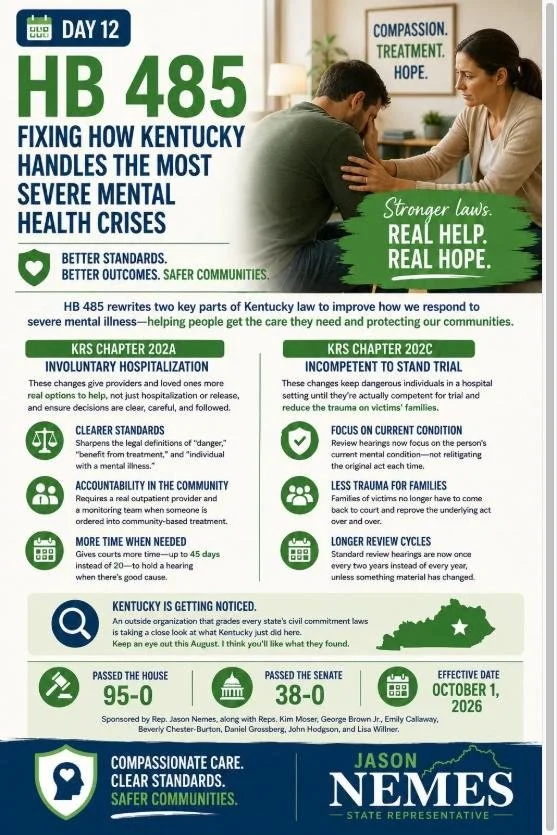
The first is KRS Chapter 202A, the law governing involuntary hospitalization for people in a mental health crisis. The changes here are about giving providers and loved ones more real options to actually help someone, instead of a system where a person either gets hospitalized or gets released with little in between. The bill sharpens the legal definitions of “danger,” “benefit from treatment,” and “individual with a mental illness” so courts, doctors, and families are working from the same clear standard instead of ambiguous language. It requires a real outpatient provider and a monitoring team to be appointed when someone is ordered into community-based treatment, so that order actually gets followed up on. And it gives courts more time, up to 45 days instead of 20, to hold a hearing when there’s good cause, so decisions aren’t rushed before all the facts are in.
The second is KRS Chapter 202C, which governs people found incompetent to stand trial due to their mental condition, often in serious, violent cases. The goal here is to keep a genuinely dangerous person in a hospital setting until they’re actually competent to face trial, rather than releasing them prematurely. Under the old law, families of victims had to come back to court and essentially reprove that the person committed the underlying act, over and over, every single review hearing. That’s real trauma, repeated again and again. HB 485 shifts the focus of these ongoing hearings to the person’s current mental condition rather than relitigating the original act each time, and it spaces out standard review hearings to once every two years instead of every year, unless something material has actually changed.
Sponsored by me, along with Reps. Kim Moser, Lisa Willner, George Brown Jr., Emily Callaway, Beverly Chester-Burton, Daniel Grossberg, John Hodgson. Passed the House 95-0. And a special thanks to the incomparable Sen. Julie Raque Adams for rolling this into her SB 122 and passing them together.
One note: this piece of the law isn’t in effect yet, it takes effect October 1, 2026.
I’ll also say this: an outside organization that grades every state’s civil commitment laws has been taking a close look at what Kentucky just did here. I’m not ready to share the details yet, but keep an eye out this August. I think you’ll like what they found.