
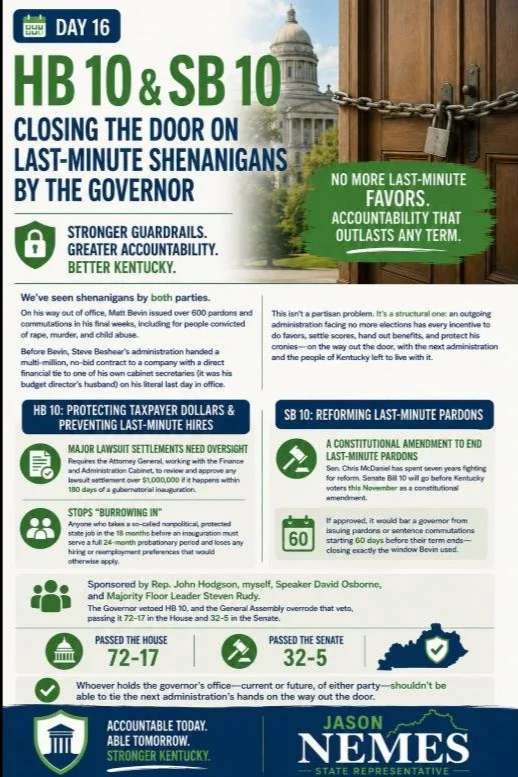
We’ve seen shenanigans by both parties. On his way out of office, Matt Bevin issued over 600 pardons and commutations in his final weeks, including for people convicted of rape, murder, and child abuse. I believe in the pardon power, but some of those pardons were inexcusable. Before Bevin, Steve Beshear’s administration handed a multi-million, no-bid contract to a company with a direct financial tie to one of his own cabinet secretaries (it was his budget director’s husband) on his literal last day in office. This isn’t a partisan problem. It’s a structural one: an outgoing administration facing no more elections has every incentive to do favors, settle scores, hand out benefits, and protect his cronies, on the way out the door, with the next administration and the people of Kentucky left to live with it.
HB 10 addresses the money and personnel side of that problem. It requires the Attorney General, working with the Finance and Administration Cabinet, to review and approve any settlement of a lawsuit worth more than $1,000,000 if it happens within 180 days of a gubernatorial inauguration. It also stops the practice of “burrowing in,” where a political appointee gets converted into a supposedly nonpolitical, protected state job right before their boss leaves office; anyone who takes such a position in the 18 months before an inauguration now has to serve a full 24-month probationary period and loses any hiring or reemployment preferences that would otherwise apply.
With regard to last-minute pardons, Sen. Chris McDaniel has spent seven years fighting for reform. His proposal, Senate Bill 10, will finally go before Kentucky voters this November as a constitutional amendment. If approved, it would bar a governor from issuing pardons or sentence commutations starting 60 days before their term ends, closing exactly the window Bevin used.
Sponsored by Rep. John Hodgson, myself, Speaker David Osborne, and Majority Floor Leader Steven Rudy. The Governor vetoed HB 10, and the General Assembly overrode that veto, passing it 72-17 in the House and 32-5 in the Senate.
Whoever holds the governor’s office, current or future, of either party, shouldn’t be able to tie the next administration’s hands on the way out the door.