Day 14: Positioning Kentucky for nuclear energy (SB 57)

Day 14: Positioning Kentucky for nuclear energy (SB 57)

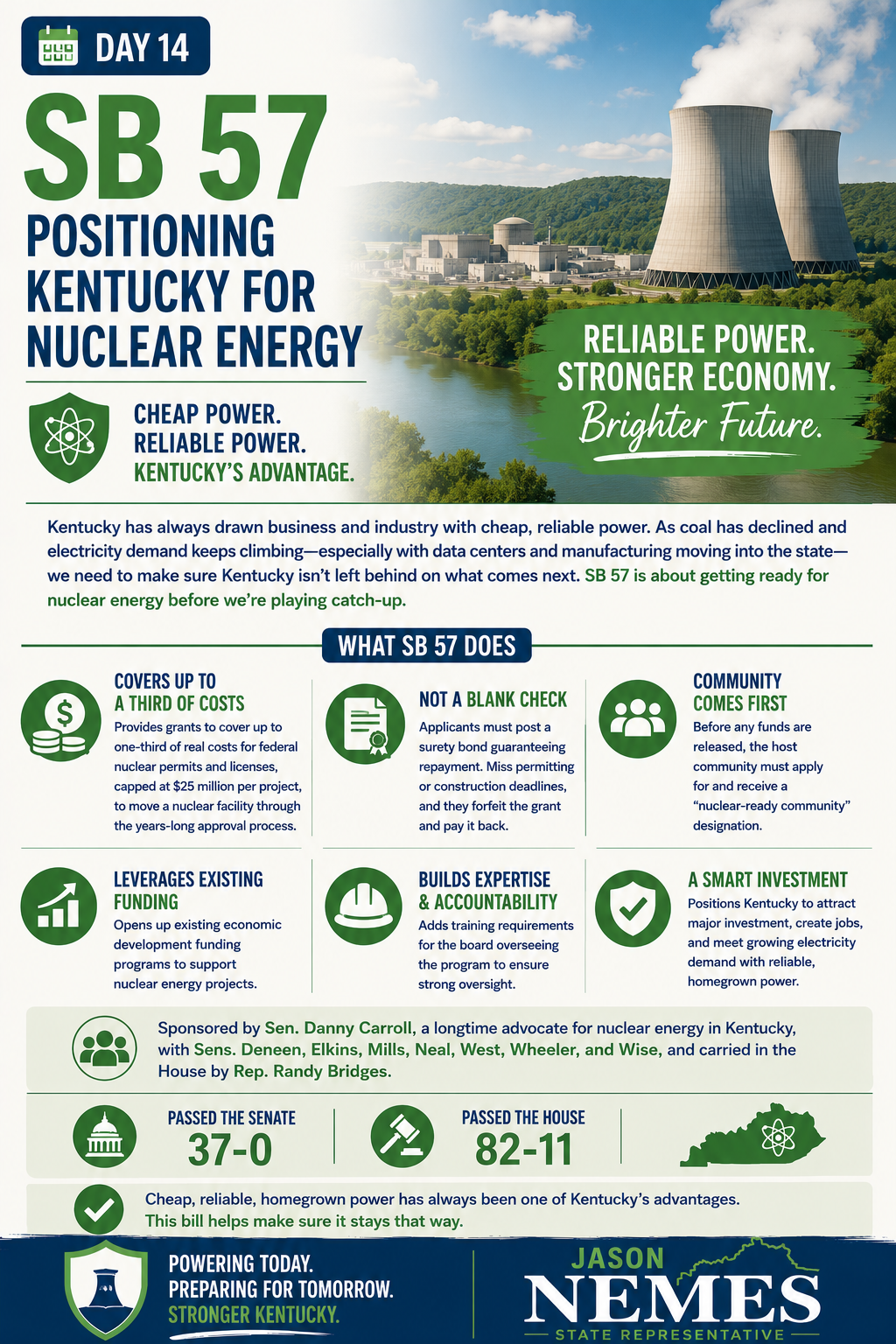
Kentucky has always drawn business and industry with cheap, reliable power. As coal has declined and electricity demand keeps climbing, especially with data centers and manufacturing moving into the state, we need to make sure Kentucky isn’t left behind on what comes next. SB 57 is about getting ready for nuclear energy before we’re playing catch-up.

The bill creates a grant program that can cover up to a third of the real costs a company faces in applying for federal nuclear permits and licenses, capped at $25 million per project, to help get a nuclear facility through the years-long federal approval process. It’s not a blank check: applicants have to post a surety bond guaranteeing repayment, and if they don’t hit their permitting or construction deadlines, they forfeit the grant and pay it back. Before any of that money moves, the community where the facility would be built has to apply for and receive a “nuclear-ready community” designation, so local buy-in comes first. The bill also opens up existing economic development funding to nuclear projects and adds training requirements for the board overseeing all of it.

Sponsored by Sen. Danny Carroll, a longtime advocate for nuclear energy in Kentucky, with Sens. Deneen, Elkins, Mills, Neal, West, Wheeler, and Wise, and carried in the House by Rep. Randy Bridges. Passed the Senate 37-0 and the House 82-11.

Cheap, reliable, homegrown power has always been one of Kentucky’s advantages. This bill helps make sure it stays that way.
Day 13: Real diploma pathways for students with disabilities (HB 562)

Day 13: Real diploma pathways for students with disabilities (HB 562)

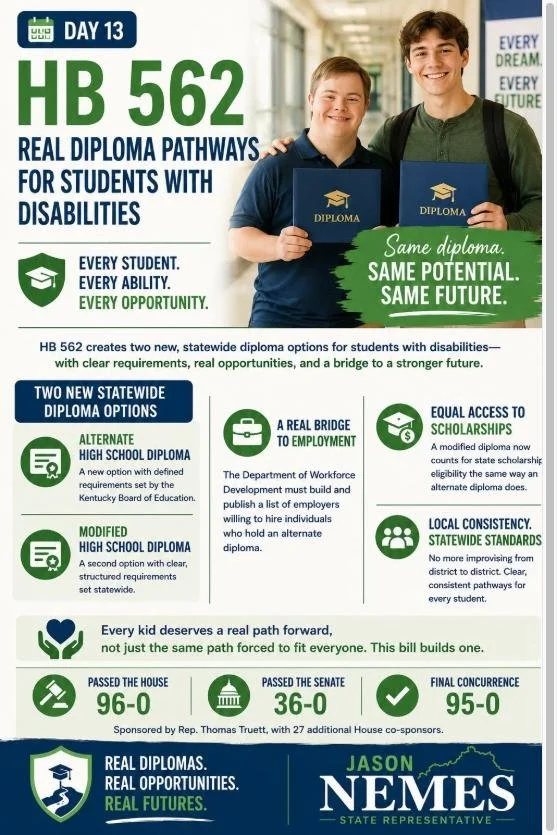
For students with disabilities who can’t meet the requirements of a standard diploma, Kentucky law didn’t offer much of a real, structured alternative, in practice, districts often improvised, and options varied district to district. HB 562 fixes that with two new statewide options: an alternate high school diploma and a modified high school diploma, each with clear, defined requirements set by the Kentucky Board of Education.

This isn’t just about handing out a piece of paper. The bill also requires the Department of Workforce Development to build and publish a list of employers actually willing to hire someone who holds an alternate diploma, so there’s a real bridge from graduation to a job. And a modified diploma now counts for state scholarship eligibility the same way an alternate diploma does, so a student isn’t shut out of financial aid because of which diploma path fit them best.

Sponsored by Rep. Thomas Truett, with 27 additional House co-sponsors. It passed the House 96-0, the Senate 36-0, and cleared final concurrence 95-0, about as close to universal agreement as you’ll find at the Capitol.

Every kid deserves a real path forward, not just the same path forced to fit everyone. This bill builds one.

Day 12: Fixing how Kentucky handles the most severe mental health crises (HB 485)

Day 12: Fixing how Kentucky handles the most severe mental health crises (HB 485)

HB 485 rewrites two different parts of how Kentucky handles severe mental illness, and both matter.

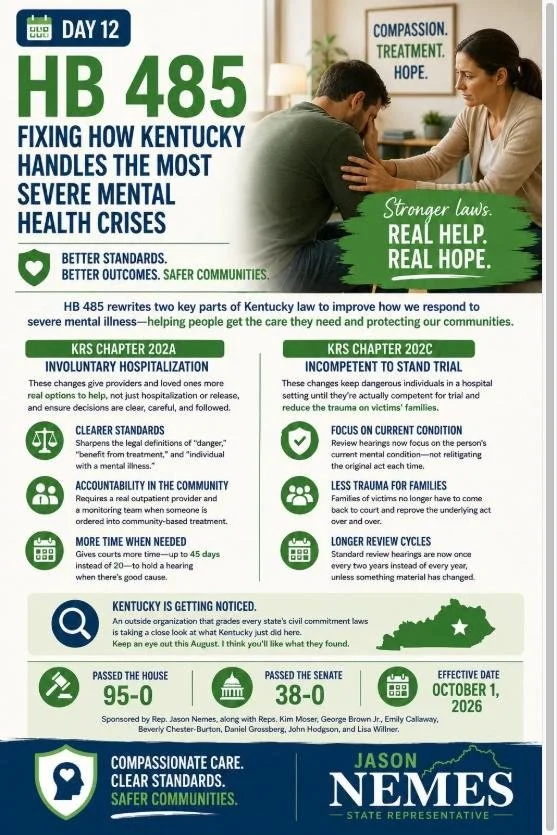
The first is KRS Chapter 202A, the law governing involuntary hospitalization for people in a mental health crisis. The changes here are about giving providers and loved ones more real options to actually help someone, instead of a system where a person either gets hospitalized or gets released with little in between. The bill sharpens the legal definitions of “danger,” “benefit from treatment,” and “individual with a mental illness” so courts, doctors, and families are working from the same clear standard instead of ambiguous language. It requires a real outpatient provider and a monitoring team to be appointed when someone is ordered into community-based treatment, so that order actually gets followed up on. And it gives courts more time, up to 45 days instead of 20, to hold a hearing when there’s good cause, so decisions aren’t rushed before all the facts are in.

The second is KRS Chapter 202C, which governs people found incompetent to stand trial due to their mental condition, often in serious, violent cases. The goal here is to keep a genuinely dangerous person in a hospital setting until they’re actually competent to face trial, rather than releasing them prematurely. Under the old law, families of victims had to come back to court and essentially reprove that the person committed the underlying act, over and over, every single review hearing. That’s real trauma, repeated again and again. HB 485 shifts the focus of these ongoing hearings to the person’s current mental condition rather than relitigating the original act each time, and it spaces out standard review hearings to once every two years instead of every year, unless something material has actually changed.

Sponsored by me, along with Reps. Kim Moser, Lisa Willner, George Brown Jr., Emily Callaway, Beverly Chester-Burton, Daniel Grossberg, John Hodgson. Passed the House 95-0. And a special thanks to the incomparable Sen. Julie Raque Adams for rolling this into her SB 122 and passing them together.

One note: this piece of the law isn’t in effect yet, it takes effect October 1, 2026.

I’ll also say this: an outside organization that grades every state’s civil commitment laws has been taking a close look at what Kentucky just did here. I’m not ready to share the details yet, but keep an eye out this August. I think you’ll like what they found.

Day 11: Better tools for families facing Alzheimer's (HB 393)

Day 11: Better tools for families facing Alzheimer’s (HB 393)

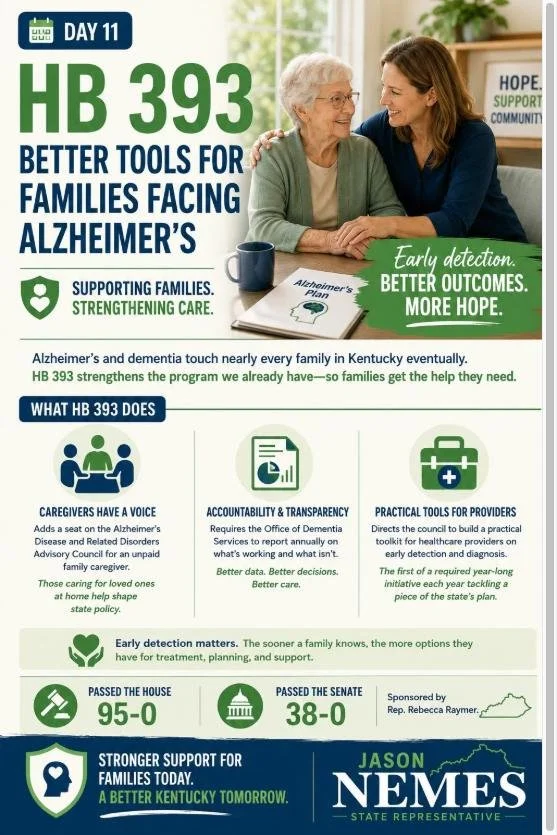
Alzheimer’s and dementia touch nearly every family in Kentucky eventually, whether it’s a parent, a grandparent, or a spouse. HB 393 doesn’t create a new program, it strengthens one we already have.

The bill adds a seat on the state’s Alzheimer’s Disease and Related Disorders Advisory Council specifically for an unpaid family caregiver, so the people actually caring for a loved one at home have a voice in shaping state policy, not just medical professionals and administrators. It also requires the Office of Dementia Services to report annually on what’s working and what isn’t, and directs the council to build a real, practical toolkit for healthcare providers on early detection and diagnosis, the first of what will now be a required year-long initiative each year tackling a piece of the state’s Alzheimer’s plan.

Early detection matters. The sooner a family knows what they’re dealing with, the more options they have for treatment, planning, and support. This bill is a small, steady step toward getting there.

Sponsored by Rep. Rebecca Raymer, HB 393 passed the House 95-0 and the Senate 38-0.

Day 10: SECOND CHANCES THROUGH SKILLED TRADES (HB 5)

Day 10: SECOND CHANCES THROUGH SKILLED TRADES (HB 5)

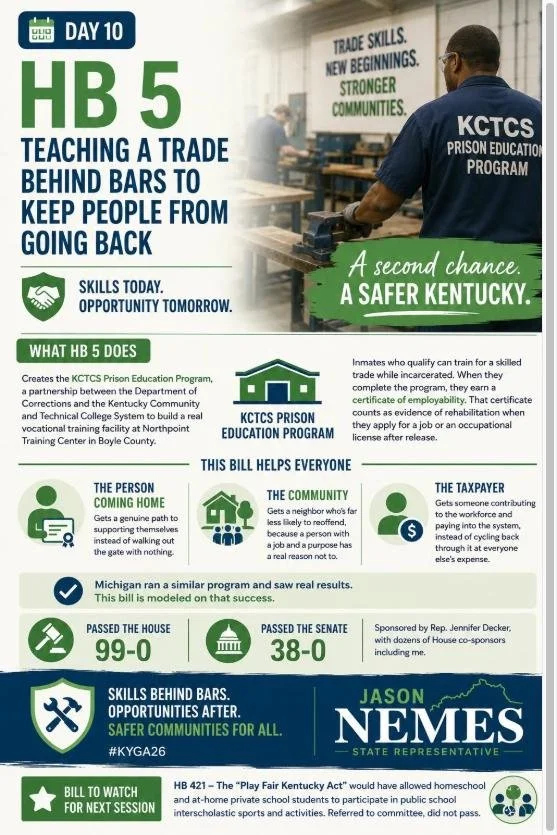
Almost everyone in a Kentucky prison right now is coming home eventually. That’s just the truth, whether we like it or not. So the real question isn’t whether that person walks back into your community someday, it’s whether they walk back in with a skill and a shot at a real job, or with nothing but a record and a high chance of ending up right back where they started.

Most Kentuckians, whatever their politics, want that first outcome. HB 5 is built around getting there. The bill creates the KCTCS Prison Education Program, a partnership between the Department of Corrections and the Kentucky Community and Technical College System to build a real vocational training facility at Northpoint Training Center in Boyle County.

Inmates who qualify (certain serious offenses disqualify someone from participating) can train for a skilled trade while they’re incarcerated, and when they complete the program, they earn a certificate of employability. That certificate counts as evidence of rehabilitation when they apply for a job or an occupational license after release, so a conviction alone can’t be used to automatically shut the door on them.

This is one of those rare bills where everybody comes out ahead. The person coming out of prison gets a genuine path to supporting themselves instead of walking out the gate with nothing. The community gets a neighbor who’s far less likely to reoffend, because a person with a job and a purpose has a real reason not to. And the taxpayer gets someone contributing to the workforce and paying into the system, instead of cycling back through it at everyone else’s expense. Michigan ran a similar program and saw real results. This bill is modeled on that success.

Sponsored by Rep. Jennifer Decker, with dozens of House co-sponsors (including me), HB 5 passed the House 99-0 and the Senate 38-0. And a special thanks to Ryan Quarles for pushing hard to make this happen as well.

Day 9: Your tax dollars shouldn't campaign against you (SB 59)

Day 9: Your tax dollars shouldn’t campaign against you (SB 59)

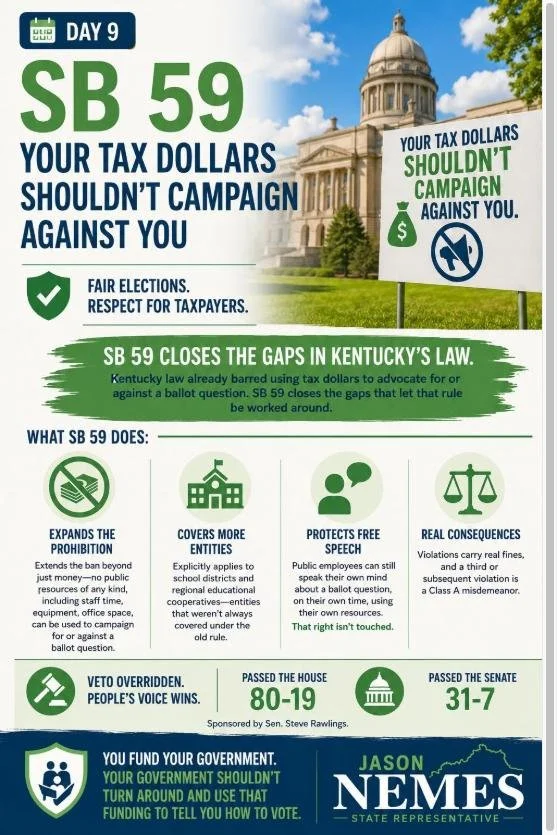
Kentucky law already barred using tax dollars to advocate for or against a ballot question. SB 59 closes the gaps that let that rule be worked around.

The new law extends the prohibition beyond just money, no public resources of any kind, staff time, equipment, office space, can be used to campaign for or against a ballot question either. A public employee can still speak their own mind about a ballot question, on their own time, using their own resources, that right isn’t touched. What changes is a government entity itself spending your tax dollars to put a thumb on the scale of an election you’re supposed to decide.

Sponsored by Sen. Steve Rawlings. The Governor vetoed the bill, and the General Assembly overrode that veto, passing it 80-19 in the House and 31-7 in the Senate.

You fund your government. Your government shouldn’t turn around and use that funding to tell you how to vote.

Day 8: Reforming Jefferson County's school board and other education policies (SB 4)

Day 8: Reforming Jefferson County's school board and other education policies (SB 4)

Day 8: Reforming Jefferson County’s school board and other education policies (SB 4)

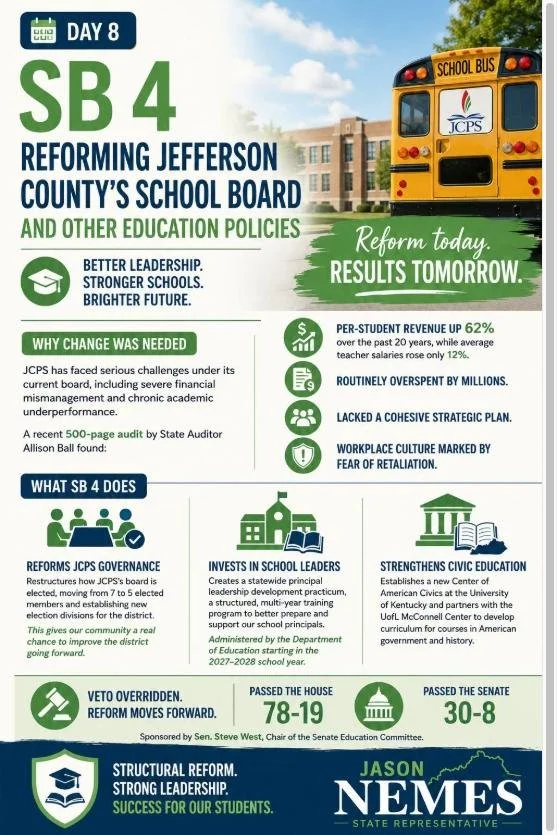
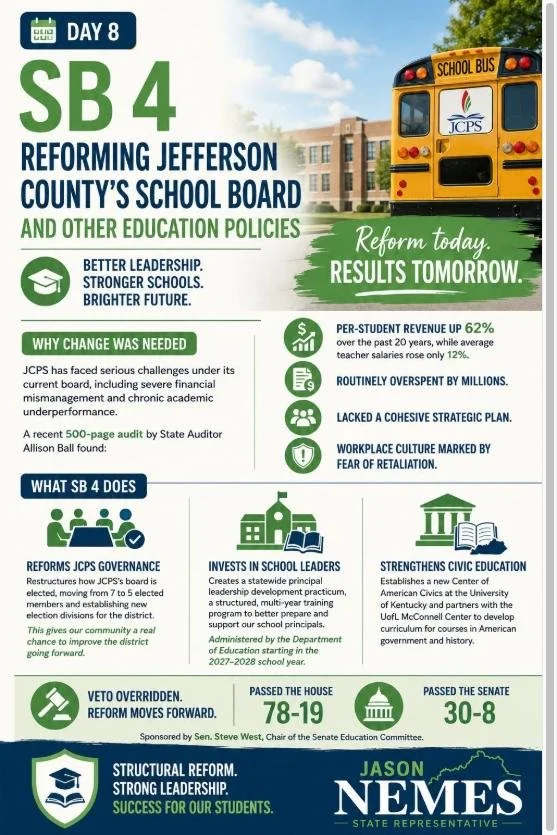
Kentucky’s largest school district, JCPS, has been dealing with real problems under its current board, including severe financial mismanagement and chronic academic underperformance in the district. SB 4 makes a structural change because the status quo wasn’t working.

The bill restructures how JCPS’s board is elected, moving from 7 to 5 elected members and establishing new election divisions for the district.. This isn’t a panacea, as no single bill fixes a district this large and badly run on its own, but with the current board being overhauled it gives our community a real chance to improve the district going forward. Recently, as many know, State Auditor Allison Ball’s office released a 500-page audit of JCPS, and the findings back up why change was needed: over the past 20 years, JCPS’s per-student revenue rose 62 percent while average teacher salaries rose only 12 percent, the district routinely overspent by millions, it lacked a cohesive strategic plan, and it had a workplace culture marked by fear of retaliation.

That alone would have been perhaps the most important bill of the session. The bill, however, does more. It also creates a statewide principal leadership development practicum, a structured, multi-year training program aimed at better preparing and supporting our school principals, who carry an enormous amount of responsibility for how well a school actually runs. The Department of Education will administer it starting with the 2027-2028 school year.

And in a piece that reaches into higher education, SB 4 establishes a new Center of American Civics at the University of Kentucky and tasks it, along with the University of Louisville’s McConnell Center, with developing curriculum materials for courses in American government and history.

Sponsored by Sen. Steve West, chair of the Senate Education Committee. The Governor vetoed the bill, and the General Assembly overrode that veto, passing it 78-19 in the House and 30-8 in the Senate.

Day 7: Protecting kids in domestic violence custody cases (HB 418 and rolled into SB 122)

Day 7: Protecting kids in domestic violence custody cases (HB 418 and rolled into SB 122)

This is a hard area of the law, hard for the parents living it, hard for the judges deciding it, and hard for those of us writing the rules they have to follow. There’s no perfect answer here, but HB 418 takes a cautious, responsible step forward on both sides of the problem.

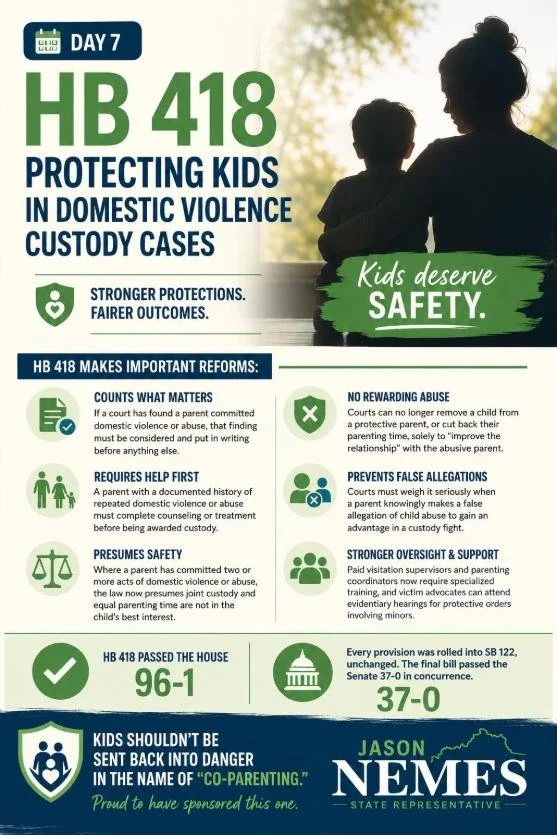
Right now, under Kentucky law, a parent who has been found to have committed domestic violence or abuse against the other parent can still walk into court and obtain joint custody or equal parenting time, with no counseling, no treatment, and no real check on that history beyond it being one factor among many a judge considers. HB 418 requires a parent with a documented history of repeated domestic violence or abuse to get help, real counseling or treatment, before that parent can be awarded custody of the child again. And to keep this fair in both directions, the bill also requires courts to weigh it seriously when a parent knowingly makes a false allegation of child abuse to gain an advantage in a custody fight, so the protections meant for real victims can’t be turned into a weapon themselves.

Here’s more of what the bill does. If a court has found that a parent committed domestic violence or abuse, that finding has to be considered and put in writing before the court weighs anything else in a custody decision. Courts can no longer remove a child from a protective parent, or cut back their parenting time, solely to “improve the relationship” with the abusive parent. Where a parent has committed two or more acts of domestic violence or abuse, the law now presumes joint custody and equal parenting time are not in the child’s best interest. Paid visitation supervisors and parenting coordinators now have to receive specialized training in these cases, and victim advocates can attend evidentiary hearings for protective orders involving minors.

HB 418 passed the House 96-1. It didn’t get a final vote in the Senate as a standalone bill, but every one of its provisions were rolled into SB 122, unchanged, where the final bill passed the Senate 37-0 in concurrence.

Kids shouldn’t be sent back into danger in the name of “co-parenting.”

Day 6: Doctors treating patients instead of fighting paperwork (HB 176)

Day 6: Doctors treating patients instead of fighting paperwork (HB 176)

Doctors should spend their time treating patients, not fighting insurance company paperwork. Not every bill we pass makes headlines, but some of the ones that don’t are the ones that matter most in people’s actual lives. HB 176 is one of them.

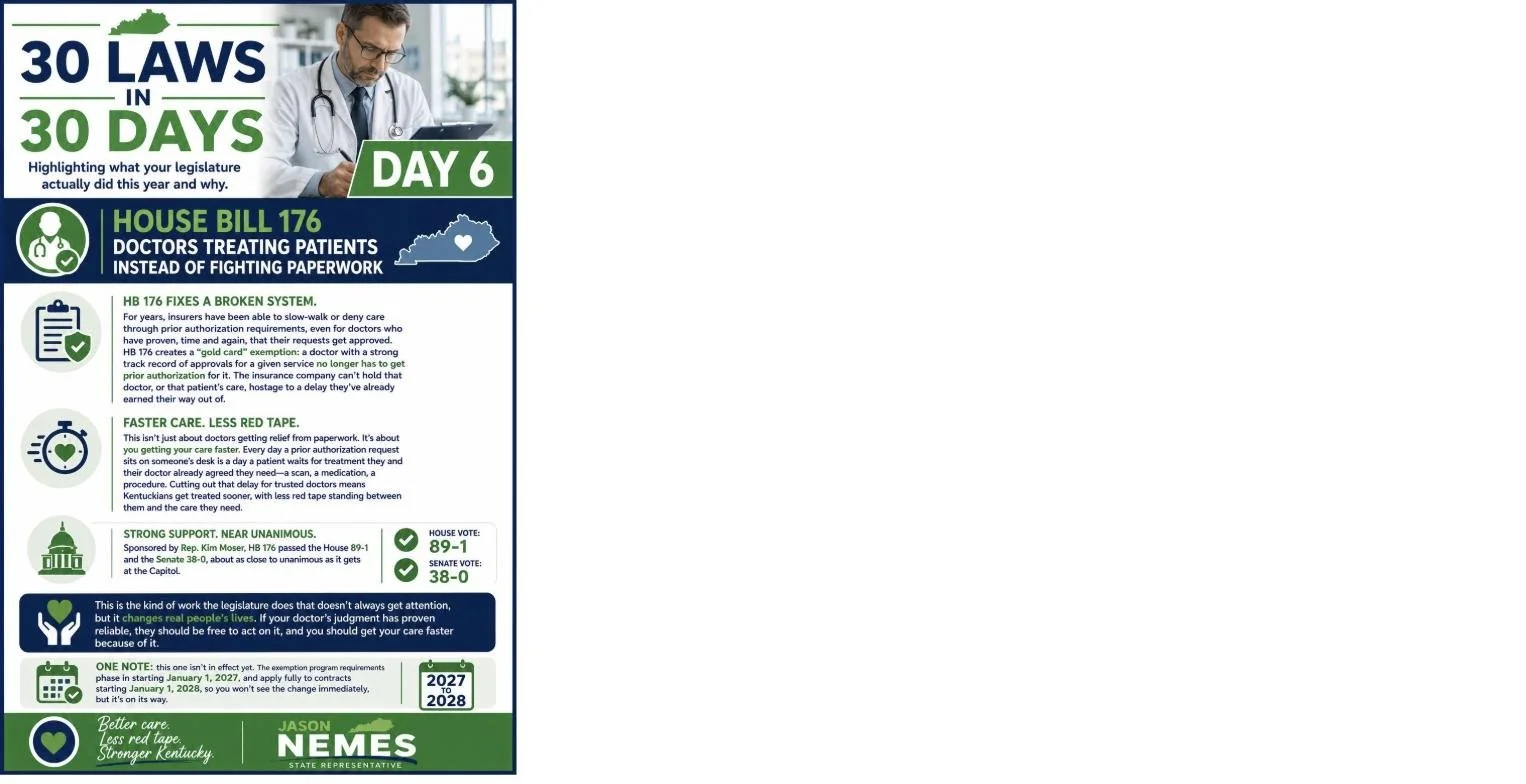
For years, insurers have been able to slow-walk or deny care through prior authorization requirements, even for doctors who have proven, time and again, that their requests get approved. HB 176 fixes that. It creates a “gold card” style exemption: a doctor with a strong track record of approvals for a given service no longer has to get prior authorization for it. The insurance company can’t hold that doctor, or that patient’s care, hostage to a delay they’ve already earned their way out of.

This isn’t just about doctors getting relief from paperwork. It’s about you getting your care faster. Every day a prior authorization request sits on someone’s desk is a day a patient waits for treatment they and their doctor already agreed they need, a scan, a medication, a procedure. Cutting out that delay for trusted doctors means Kentuckians get treated sooner, with less red tape standing between them and the care they need.

Sponsored by Rep. Kim Moser, HB 176 passed the House 89-1 and the Senate 38-0, about as close to unanimous as it gets at the Capitol.

This is the kind of work the legislature does that doesn’t always get attention, but it changes real people’s lives. If your doctor’s judgment has proven reliable, they should be free to act on it, and you should get your care faster because of it.

One note: this one isn’t in effect yet. The exemption program requirements phase in starting January 1, 2027, and apply fully to contracts starting January 1, 2028, so you won’t see the change immediately, but it’s on its way.

Day 5: Keeping families together where it's safe to do so (SB 122)

Day 5: Keeping families together where it’s safe to do so (SB 122)

The family is the core building block of civilization. Everything else, our schools, our churches, our communities, works better when families stay intact. So when the law can protect that bond without compromising safety, it should.

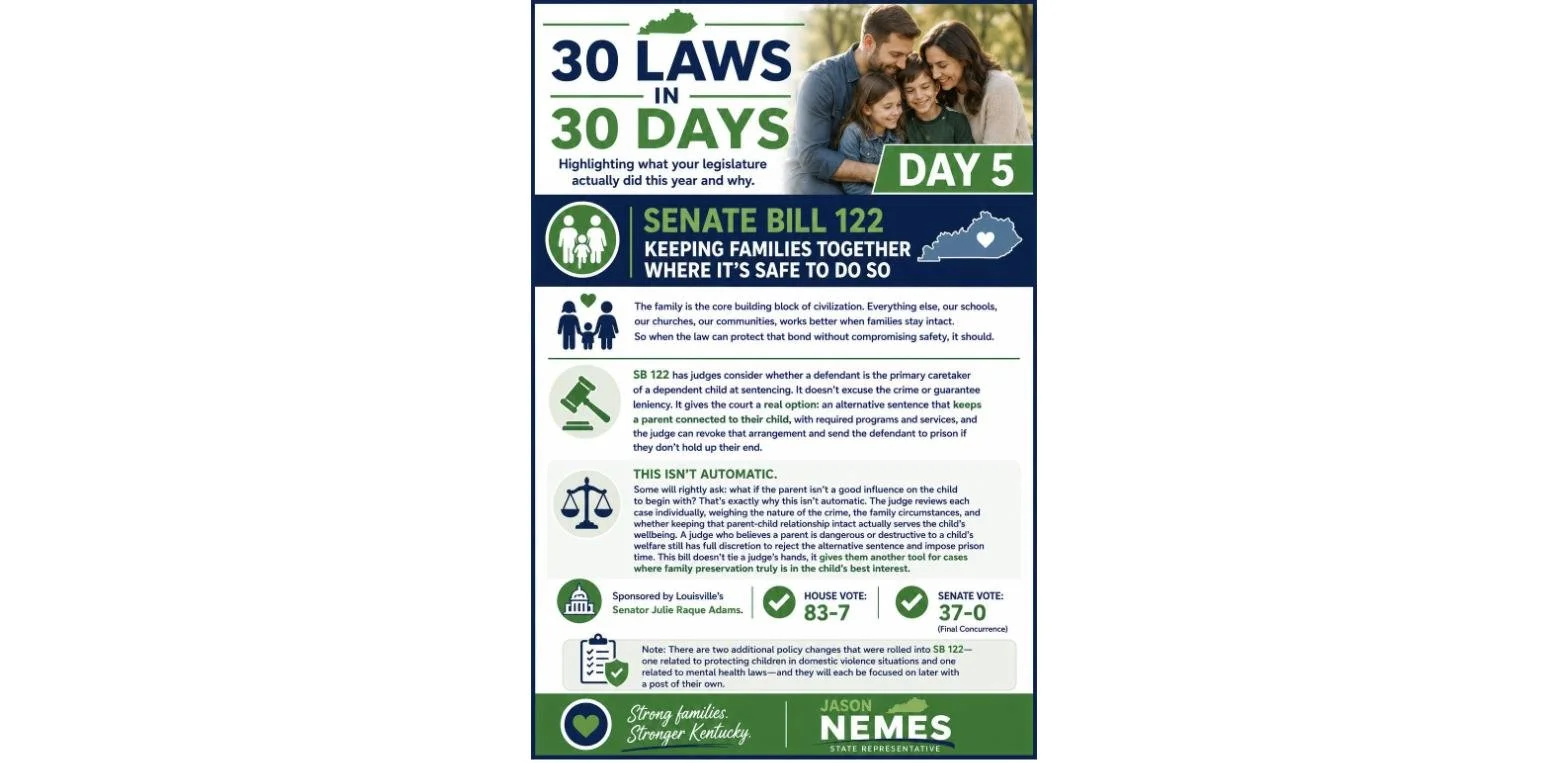
SB 122 has judges consider whether a defendant is the primary caretaker of a dependent child at sentencing. It doesn’t excuse the crime or guarantee leniency. It gives the court a real option: an alternative sentence that keeps a parent connected to their child, with required programs and services, and the judge can revoke that arrangement and send the defendant to prison if they don’t hold up their end.

Some will rightly ask: what if the parent isn’t a good influence on the child to begin with? That’s exactly why this isn’t automatic. The judge reviews each case individually, weighing the nature of the crime, the family circumstances, and whether keeping that parent-child relationship intact actually serves the child’s wellbeing. A judge who believes a parent is dangerous or destructive to a child’s welfare still has full discretion to reject the alternative sentence and impose prison time. This bill doesn’t tie a judge’s hands, it gives them another tool for cases where family preservation truly is in the child’s best interest.

Sponsored by Louisville’s Senator Julie Raque Adams. Passed the House 83-7 and the Senate, in final concurrence, 37-0.

(Note: There are two additional policy changes that were rolled into SB 122–one related to protecting children in domestic violence situations and one related to mental health laws—,and they will each be focused on later with a post of their own.)