Day 7: Protecting kids in domestic violence custody cases (HB 418 and rolled into SB 122)
This is a hard area of the law, hard for the parents living it, hard for the judges deciding it, and hard for those of us writing the rules they have to follow. There’s no perfect answer here, but HB 418 takes a cautious, responsible step forward on both sides of the problem.
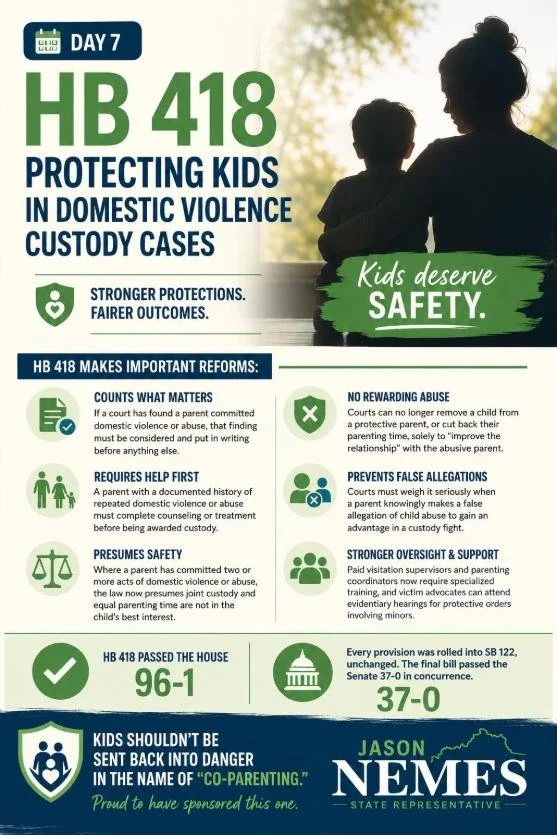
Right now, under Kentucky law, a parent who has been found to have committed domestic violence or abuse against the other parent can still walk into court and obtain joint custody or equal parenting time, with no counseling, no treatment, and no real check on that history beyond it being one factor among many a judge considers. HB 418 requires a parent with a documented history of repeated domestic violence or abuse to get help, real counseling or treatment, before that parent can be awarded custody of the child again. And to keep this fair in both directions, the bill also requires courts to weigh it seriously when a parent knowingly makes a false allegation of child abuse to gain an advantage in a custody fight, so the protections meant for real victims can’t be turned into a weapon themselves.
Here’s more of what the bill does. If a court has found that a parent committed domestic violence or abuse, that finding has to be considered and put in writing before the court weighs anything else in a custody decision. Courts can no longer remove a child from a protective parent, or cut back their parenting time, solely to “improve the relationship” with the abusive parent. Where a parent has committed two or more acts of domestic violence or abuse, the law now presumes joint custody and equal parenting time are not in the child’s best interest. Paid visitation supervisors and parenting coordinators now have to receive specialized training in these cases, and victim advocates can attend evidentiary hearings for protective orders involving minors.
HB 418 passed the House 96-1. It didn’t get a final vote in the Senate as a standalone bill, but every one of its provisions were rolled into SB 122, unchanged, where the final bill passed the Senate 37-0 in concurrence.
Kids shouldn’t be sent back into danger in the name of “co-parenting.”