
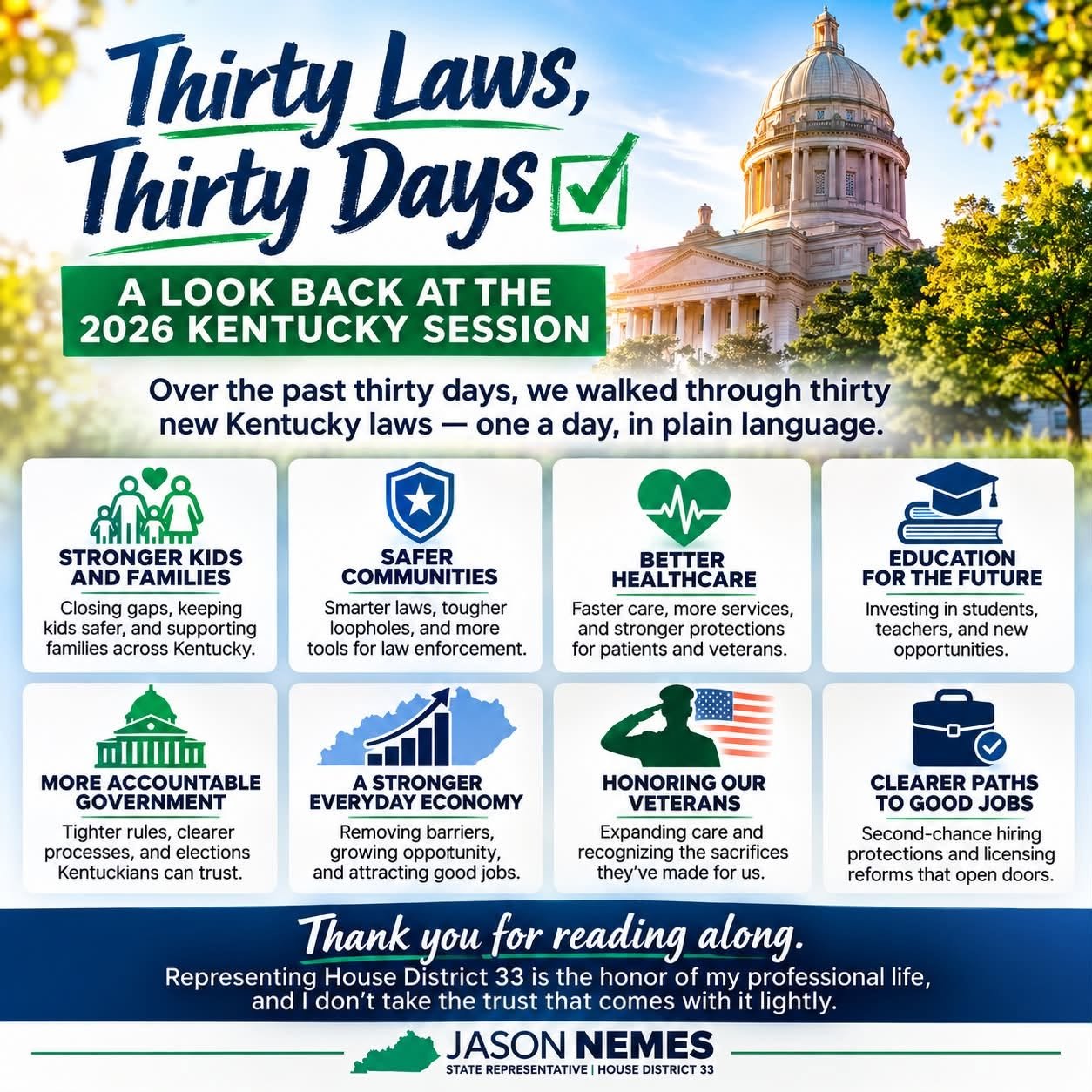
Over the past thirty days, this page has walked through thirty different laws that came out of the 2026 Kentucky General Assembly, one a day, in plain language, with the sponsors and the vote counts included every time. Now that the series is finished, it’s worth stepping back and looking at what that body of work actually adds up to.
A significant share of what passed this session was about protecting kids and families. Kentucky closed a gap in its grooming laws, expanded the network of trained nurses who examine survivors of sexual assault, tightened school threat reporting, reformed how custody is handled in domestic violence cases, and updated the law on child sexual abuse material to account for AI-generated images that didn’t exist when the original statute was written.
Another large piece dealt with public safety and the criminal justice system directly. Kentucky overhauled its civil commitment process, closed the insanity defense loophole exposed by Logan Tipton’s case, restructured how the Parole Board is staffed and how it holds hearings, modernized the stalking statute for the social media era, and extended a trained, background-checked path to concealed carry to 18- to 20-year-olds (who could previously openly carry without restrictions) to increase the numbers of trained citizens who carry firearms.
Healthcare access came up again and again: a faster prior authorization process for patients whose doctors and insurers agree on a plan of care, expanded Alzheimer’s and dementia services, a mandatory pause built into the organ donation process, hyperbaric oxygen therapy access for veterans with PTSD, and a new insurance requirement covering prosthetic and orthotic devices, including the kind built for an active life.
Kentucky also acted on education, from a new tax credit program to JCPS board restructuring to expanding prison education, on government accountability, from gubernatorial transition rules to election administration updates, and on the everyday economy, from second-chance hiring protections to interstate licensing compacts that let more professionals work here without starting over.
I take this job seriously in a few different ways: informing the people I represent about what their government is actually doing, in plain terms, not press-release language, thinking hard about the policy itself before I ever cast a vote, and helping constituents directly when they run into trouble with their government, which is its own kind of work this series doesn’t cover but matters just as much. That’s what I’ve tried to bring to this series for thirty days straight, bill by bill, vote by vote, sourced against the primary legislative record every time. If you want to see the complete list of everything that passed this session, not just the thirty covered here, the Legislative Research Commission’s full report is linked at the end of this post.
Representing House District 33 is the honor of my professional life, and I don’t take the trust that comes with it lightly. Thank you for reading along.
Read the Legislative Research Commission’s full 2026 session report