We Need to Talk About Flock Cameras and Citizens’ Privacy Rights
I’ve been knocking on a lot of doors in our district lately, and this comes up on porches more than almost anything else right now. You’ve probably seen the cameras yourself: the small poles popping up on utility posts and intersections around the city. They read license plates, log where a car has been, and let police search that data when they’re investigating a crime. Some of you love them. Some of you hate them. I think most of us are somewhere in the middle, and I want to make the case for both sides before I tell you where I’ve landed.
This past session, the General Assembly took a first step here. Rep. John Hodgson’s HB 58 put statewide rules on these cameras for the first time, capping how long agencies can keep the data, requiring an officer to visually confirm a plate match before a stop, and banning the sale of the raw data to third parties. It was a real, meaningful step. I don’t think it’s the last one we need to take.
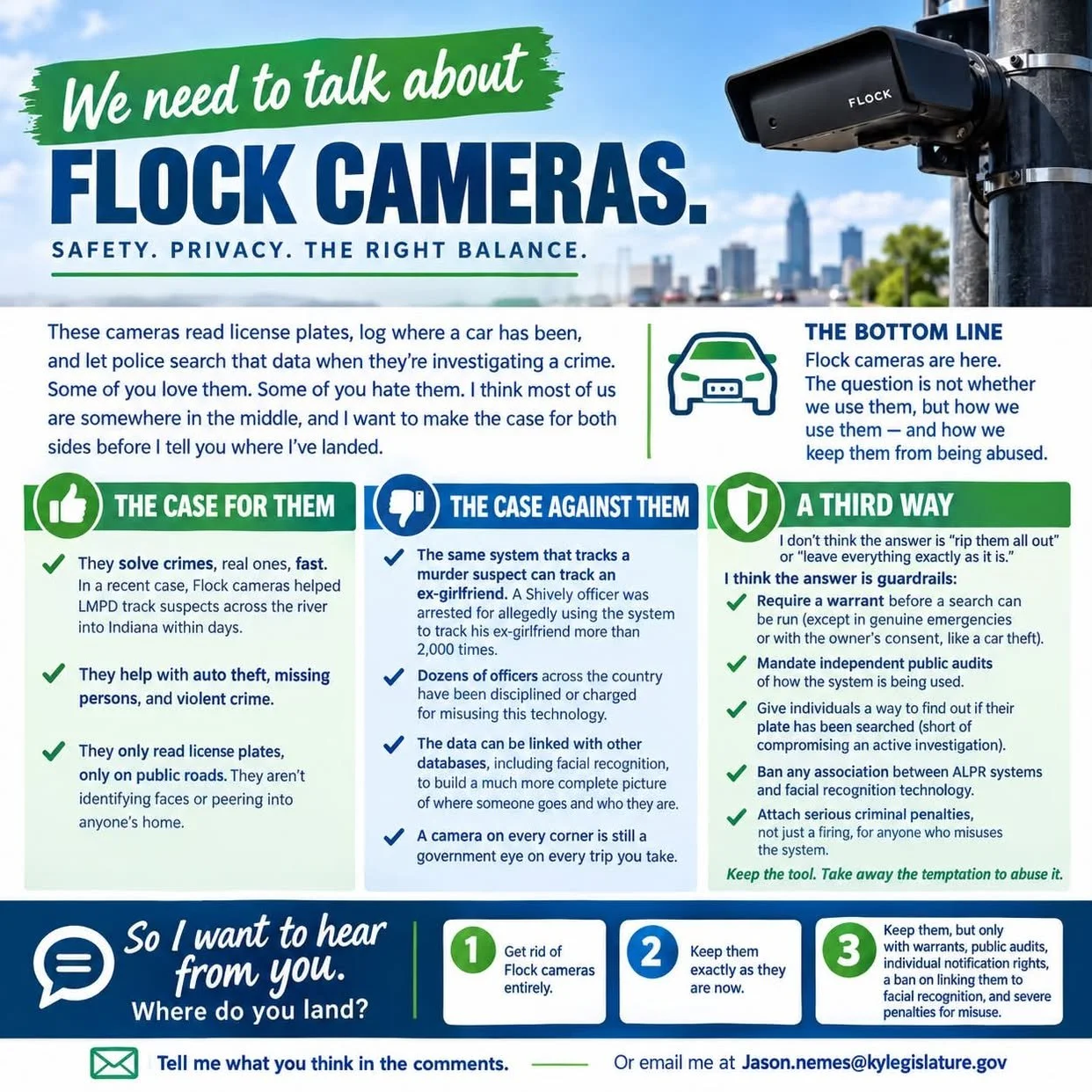
The Case for Them
These cameras solve crimes, real ones, fast. When 16 year old Dannady Greene was shot and killed while waiting for a bus in Park Duvalle last month, Flock cameras helped LMPD track the suspects’ vehicle across the river into Indiana within days. That is not a hypothetical benefit. That is a family getting an answer, and a community getting two dangerous people off the street, in less than a week. Departments across the country report similar results with auto theft, missing persons cases, and violent crime. For a city that has struggled with its clearance rate on serious crimes, that kind of tool is hard to dismiss. Proponents also point out, fairly, that these cameras only read license plates, and only on public roads. They aren’t identifying faces or peering into anyone’s home.
The Case Against Them
The same system that tracks a murder suspect can just as easily track an ex-girlfriend. In August, a Shively officer was arrested for allegedly using the Flock system to track his ex-girlfriend’s location more than 2,000 times. He is far from alone. A public interest law firm has documented dozens of officers across the country who were disciplined or criminally charged for using this exact technology to stalk former partners, spouses, or people they were simply curious about. Opponents also raise a broader worry: that this data can be linked with other databases and technologies, including facial recognition, to build a much more complete picture of where someone goes and who they are than a single license plate ever could. And they argue that a camera on every corner, even one that only reads plates, is still a government eye on every trip you take, which is its own kind of privacy loss regardless of whether any single officer misuses it.
A Third Way
I don’t think the answer is “rip them all out” or “leave everything exactly as it is.” I think the answer is guardrails: require a warrant before a search can be run except in genuine emergencies or unless the owner gives consent (like with a car theft), mandate independent public audits of how the system is being used, give individuals a way to find out if their plate has been searched (short of compromising an active investigation), ban any association between ALPR systems and facial recognition technology, and attach serious criminal penalties, not just a firing, for anyone who misuses the system. Keep the tool. Take away the temptation to abuse it.
So I want to hear from you. Where do you land?
Get rid of Flock cameras entirely.
Keep them exactly as they are now.
Keep them, but only with warrants, public audits, individual notification rights, a ban on linking them to facial recognition, and severe penalties for misuse.
Please send me an email at jason.nemes@kylegislature.gov and tell me where you land and why. I read every one.