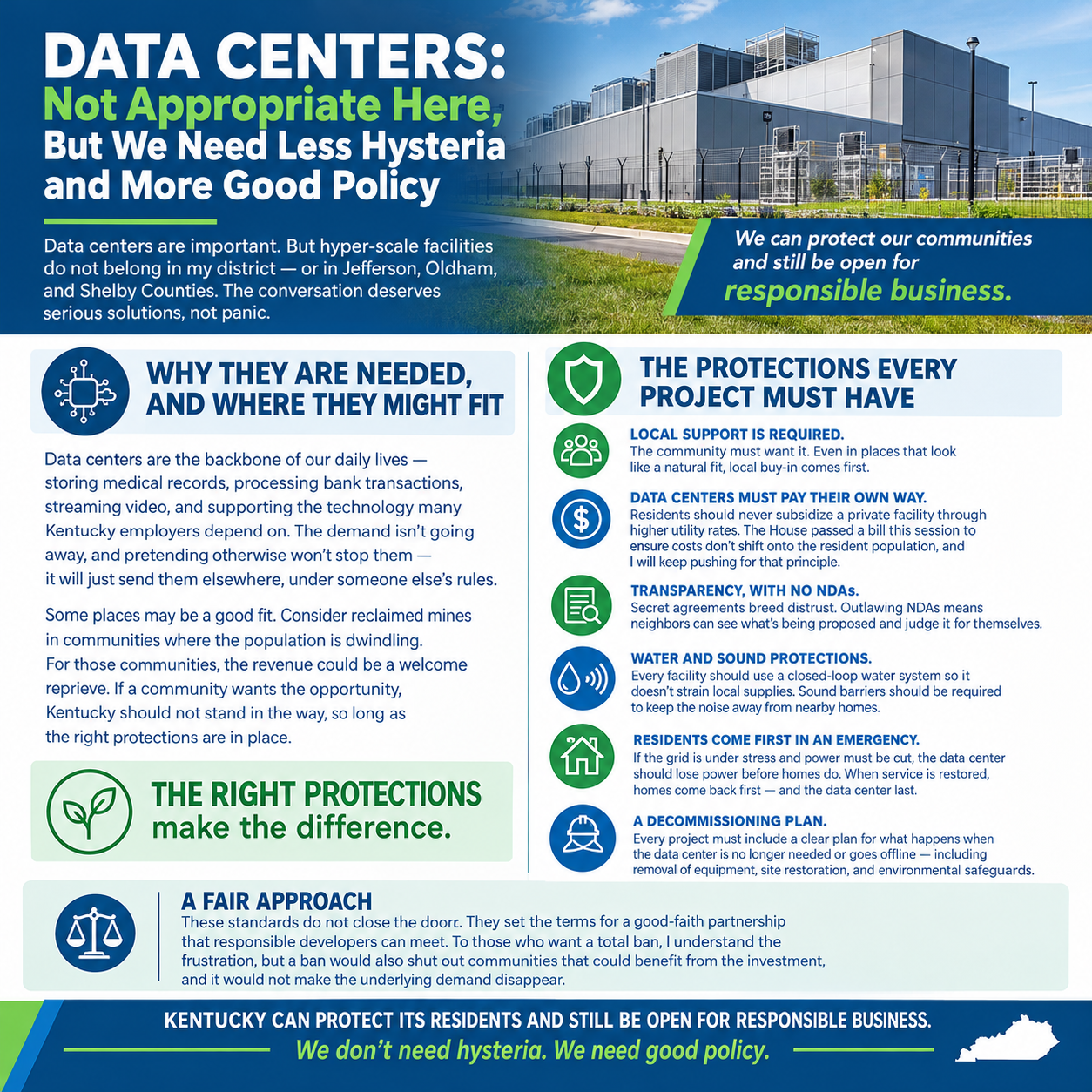
Data Centers: Not Appropriate Here, But We Need Less Hysteria and More Good Policy
Let me start with where I stand. I am against hyper-scale data centers in my district, and in Jefferson, Oldham, and Shelby Counties more broadly. These facilities are enormous, and they do not belong in communities this densely populated.
But the conversation around data centers has gotten loud, and some of the proposals, including calls to outlaw them entirely, miss the mark. People worry about their power bills, their water, and the character of their neighborhoods. Those are fair concerns, and they deserve a serious answer. That answer is good policy, not panic.
Why They Are Needed, and Where They Might Fit
Data centers are the backbone of much of our daily lives, and they are becoming more and more necessary. They store medical records, process bank transactions, stream video, and support the technology many Kentucky employers depend on. The demand is not going away, and pretending otherwise would not stop them from being built. It would only mean they get built elsewhere, under someone else’s rules.
Some places may be a good fit. Consider reclaimed mines in communities where the population is dwindling. For those communities, the revenue from a data center could be a welcome reprieve. If a community wants that opportunity, Kentucky should not stand in the way, so long as the right protections are in place.
The Protections Every Project Must Have
Local support is required. Where a data center might make sense, the community must want it. Even in places that look like a natural fit, local buy-in comes first.
Data centers must pay their own way. Residents should never subsidize a private facility through higher utility rates. This is not just a theoretical concern. In the 2026 session, the Kentucky House passed House Bill 593, sponsored by Rep. Josh Bray, by a vote of 90–8. The bill would have required utilities to ensure that data centers paid their fair share of the electricity service and infrastructure they require, rather than shifting those costs onto other customers. Unfortunately, the Senate did not advance the legislation, and it did not become law.
That is unfinished business. I support the principle behind HB 593, and I will continue pushing for meaningful protections so Kentucky families and businesses do not end up paying for the enormous energy demands of private data centers.
Transparency, with no NDAs. Secret agreements breed distrust, and residents should not be the last to know. Outlawing nondisclosure agreements in these deals means neighbors can see what is being proposed and judge it for themselves.
Water and sound protections. Every facility should use a closed-loop water system so it does not strain local supplies. Sound barriers around the property should be required to keep the noise away from nearby homes.
Residents come first in an emergency. If the grid is under stress and power must be cut, the data center should lose power before homes do. When service is restored, homes should come back first and the data center last.
A decommissioning plan is required. Every project should have a clear, enforceable plan for what happens when the data center is no longer needed, shuts down, or goes offline permanently. That plan should address the removal of equipment and infrastructure, cleanup and restoration of the property, and responsibility for any environmental damage. Developers should have to demonstrate up front that they can meet these obligations, including setting aside adequate financial resources to carry them out.
We should not allow a company to leave a community with an abandoned facility, an environmental problem, or a costly cleanup bill for taxpayers to inherit. If a developer profits from building and operating a data center, that developer should also be responsible for leaving the site in a condition that protects the community when the project ends.
A Fair Approach
Some will say these rules go too far, and others will say they do not go far enough. To those worried about jobs and investment, these standards do not close the door. They set the terms for a good-faith partnership that responsible developers can meet.
To those who want a total ban, I understand the frustration, but a ban would also shut out communities that could benefit from the investment, and it would not make the underlying demand disappear.
Kentucky can protect its residents and still be open for responsible business. We can insist on local support, protect ratepayers, safeguard water supplies, demand transparency, and require developers to take responsibility for their projects from beginning to end.
We do not need hysteria. We need good policy.