
Recently we have all heard that some members of the JCPS School Board are talking about raising taxes to address their $188 million budget deficit. Let me be clear: that deficit exists because of overspending, not a lack of revenue. And the legislature has been working to protect you from more tax increases.
Here's what you need to know.
What JCPS Wanted to Do:
The School Board had their eye on new taxes, including adding a tax on your utility bills. I worked specifically to take that off the table, along with any other new taxes JCPS might have tried to levy. The legislature's actions this year made sure that option is no longer available to them.
Why These Protections Matter: A Recent Lesson
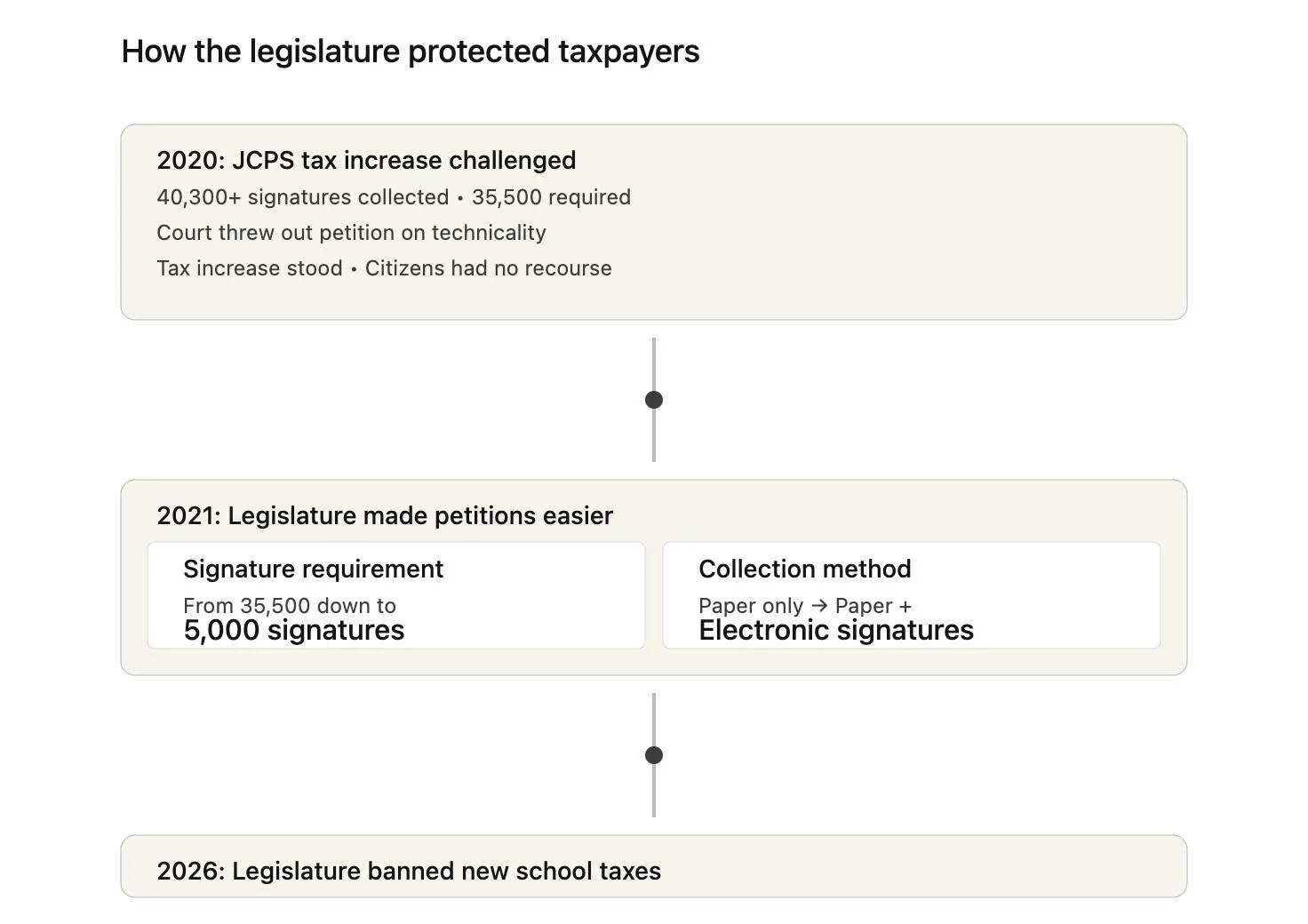
This isn't theoretical. In 2020, JCPS approved a 9.5 percent property tax increase and they have been talking about raising it again this year. Citizens who opposed that 9.5 percent increase collected over 40,000 signatures on a petition to force a ballot question so voters could decide the issue. But here's the problem: under the law at that time, they needed signatures equal to 10 percent of voters in the district. For Jefferson County, that meant roughly 35,500 signatures were required. The petition had enough valid signatures to qualify—but the court threw out the entire petition on a technicality involving how some signatures were collected electronically. The tax increase stood and we are paying that increase today. JCPS kept the money.
But our citizens were rightfully frustrated, so the legislature responded by making it dramatically easier for people to challenge large tax increases.
In particular, we reduced the signature requirement from 35,500 down to just 5,000 signatures. That is roughly 86 percent fewer people needed to demand a ballot vote. We also authorized electronic signatures, so you can sign a petition on your phone or computer instead of having to find paper copies. (Kevin D. Bratcher and Ken Fleming for Kentucky led that effort to protect our citizens.)
This wasn't about stopping necessary taxes. It was about making sure that when school boards want to take significantly more money from your paycheck and property, you have a real, practical way to demand a vote.
As I noted above, that high tax increase went into effect. Yet JCPS, in all their glorious incompetence, still got into a $188 million hole. So some of the JCPS Board members have been chirping about raising taxes again, both on your property and in finding new taxes, like taxing your utility bill. So this past session, in HB 757, we went further. The legislature specifically prohibited JCPS and other school boards from:
- Levying any new occupational or personal property taxes (the kinds of taxes on your vehicles, income, ,and utilities that JCPS was eyeing)
- Raising the rates of any occupational or personal property taxes that already exist
Why This Matters to You
You already pay more than enough taxes. Jefferson County residents support public services through state income tax, sales tax, property tax, and local taxes. When school boards face budget challenges, especially of their own making, the solution should not be unlimited new taxes. It should be managing the resources they have responsibly.
The legislature's job is to balance protecting essential services with protecting hardworking Kentuckians from endless tax increases. These protections do exactly that.
Note: I want to note that our new Superintendent has consistently said that he does not support raising taxes, as he thinks the school district needs to get its house in order before even thinking about coming to the voters for a tax increase. I agree with him and want to give him kudos for taking that position. I hope JCPS does get its financial house in order, so our new Superintendent can get to what he was hired to do, which is to improve academic achievement. The current budgetary deficit is the fault of previous school board members.
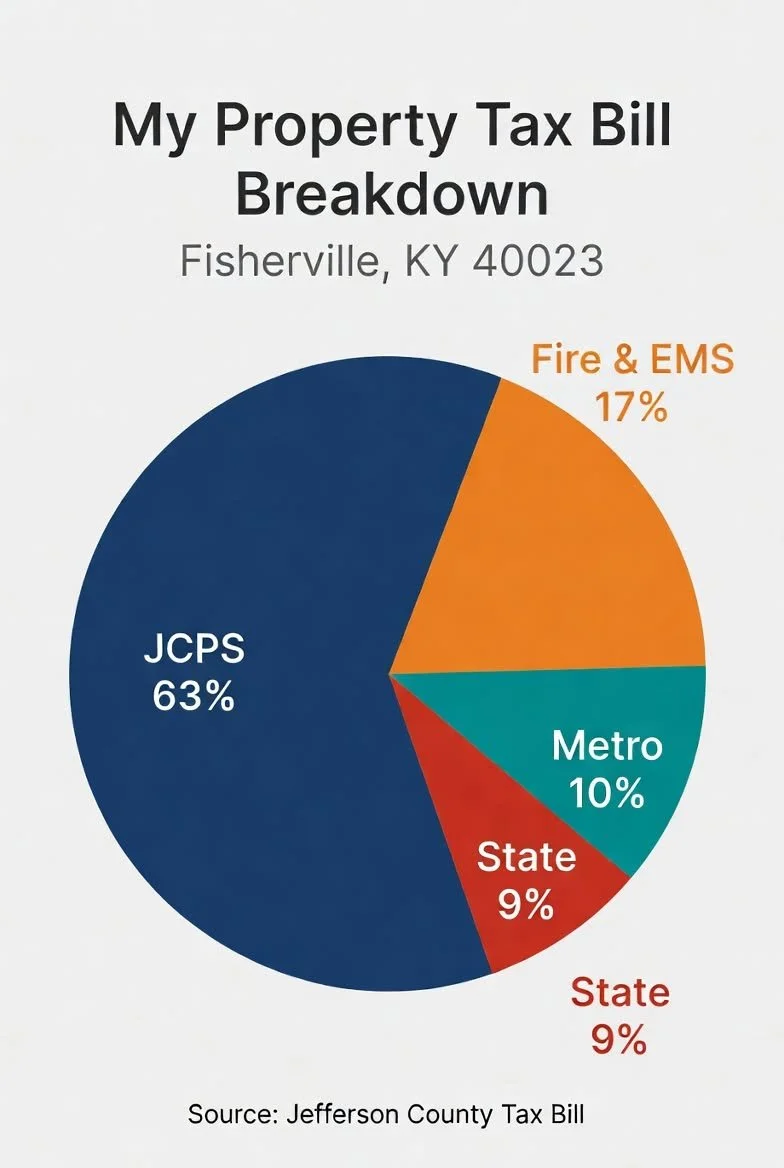
This information was compiled based on the taxes of a citizen who lives in Fisherville. The percentages may slightly change based on where you live, such as whether you live in a suburban city, an unincorporated area, or in Oldham or Shelby Counties.